


Introduction
The email sat near the top of your inbox: "Re: our call last week". You stopped what you were doing to work out which call. There was no call. It was a pitch from someone you had never spoken to, dressed up as the middle of a conversation. You did not reply, and the next email from that sender went straight to the spam folder, by your own hand.
Now someone on your own team suggests the same trick because "it gets opens". The short answer: RE: in an email subject line tells the reader the message is a reply to something they sent or received. On a first cold email that is false, and Google's sender guidelines, Yahoo's sender best practices and the FTC's CAN-SPAM guide all rule out subject lines that misrepresent the message. RE: is honest only on a real reply, such as a follow-up you send in the same thread.
What RE: In An Email Subject Line Means
RE: marks a reply. RFC 5322, the standard for the format of an email, says a reply's subject may start with "Re: ", which it describes as an abbreviation of the Latin "in re", meaning "in the matter of", followed by the original subject. It adds that only one "Re: " ought to be used. Fwd: or FW: marks a forward by the same convention.
Mail apps in other languages write their own prefixes, so a fake reply is not always spelled in English. These are the prefixes our tester recognises at the start of a subject, with or without a counter such as "Re[2]:":
| Prefix | Meaning | Where you see it |
|---|---|---|
| RE: | Reply | English and many other languages |
| FW: or FWD: | Forward | English |
| AW: and WG: | Antwort (reply), Weitergeleitet (forwarded) | German |
| SV: | Svar (reply) | Swedish, Danish, Norwegian |
| VS: | Vastaus (reply) | Finnish |
| ANTW: | Antwoord (reply) | Dutch |
| TR: | Transféré (forwarded) | French |
| RV: | Reenviado (forwarded) | Spanish |
| ENC: | Encaminhado (forwarded) | Portuguese |
What A Real Reply Carries That A Fake One Does Not
A genuine reply is more than a subject with a prefix. Section 3.6.4 of RFC 5322 defines two headers that tie it to the message it answers: In-Reply-To names the parent message, and References lists the whole chain. Mail apps use them, along with the subject, to show the messages as one conversation. A fake reply has the prefix and nothing else, which is why RE: in a subject line proves nothing on its own.
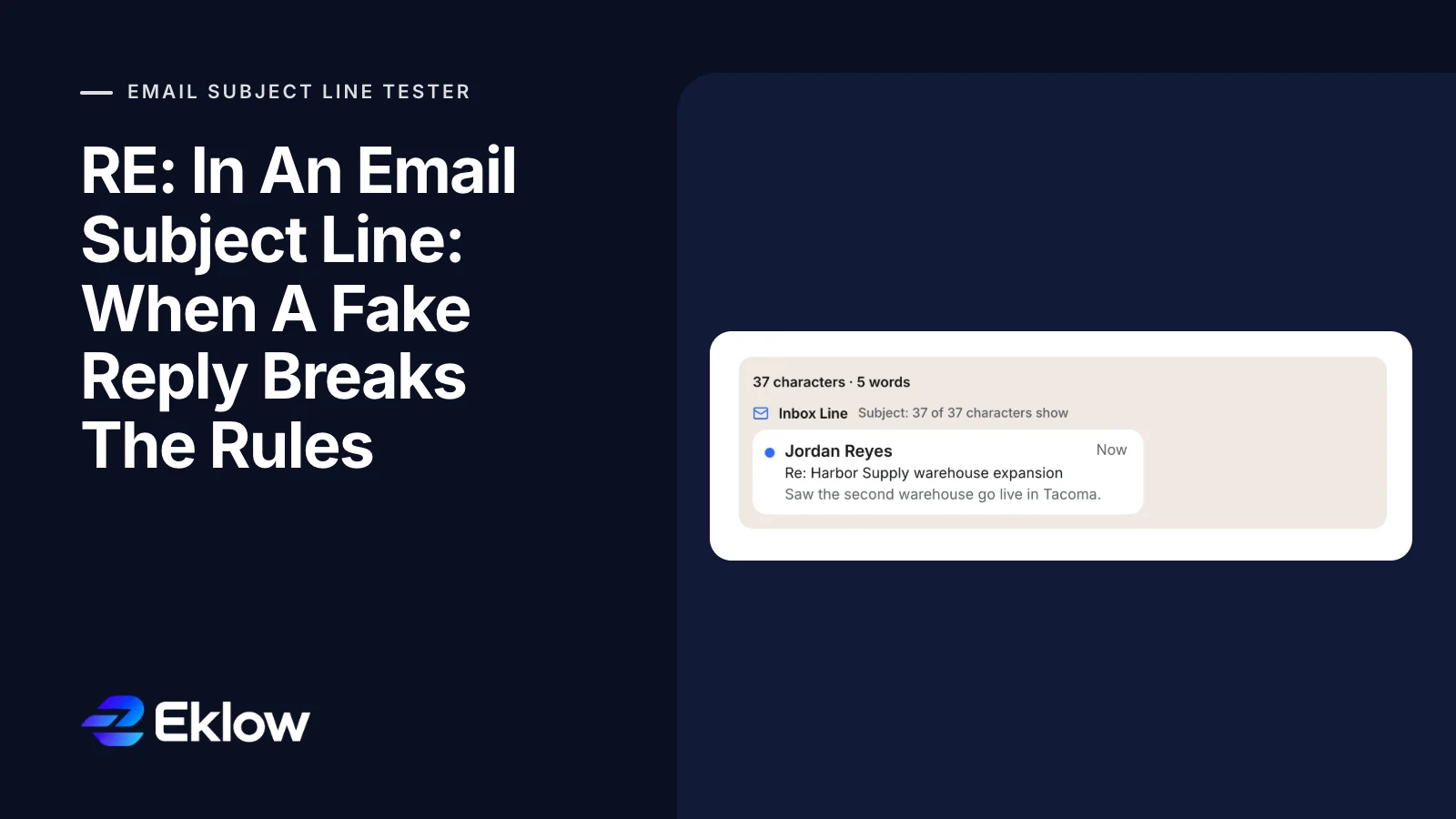
Subject: Re: Harbor Supply warehouse expansion
In-Reply-To: <[email protected]>
References: <[email protected]>
When the reader opens a real follow-up, your first email sits right above it in the thread. When they open a fake one, there is nothing above it, and the claim in the subject falls apart in the first second.
What Google, Yahoo And The FTC Say About Fake Reply Subject Lines
Three primary sources cover this, and none of them leaves room for a fake RE: on a first email:
| Source | What it says | Who it covers |
|---|---|---|
| Google email sender guidelines | Subjects and headers should not be misleading; do not send messages whose subject starts with Re: or Fwd: unless they are actual replies or forwards. | Anyone sending to Gmail addresses |
| Yahoo sender best practices | Do not use deceptive subject lines to hide, forge or misrepresent the sender or origin of the email. | Anyone sending to Yahoo and AOL addresses |
| FTC CAN-SPAM compliance guide | Do not use deceptive subject lines; the subject must accurately reflect the content of the message. | Commercial email in the US, business to business included |
The FTC guide is explicit that the law makes no exception for business-to-business email, that both the company whose product is promoted and the company that sends the message can be held responsible, and that each email in violation can bring a penalty of up to $53,088. Other countries have their own laws, and this is not legal advice. The point stands on its own, though: a fake reply prefix makes a claim about the message that is not true.
Why "It Gets Opens" Is The Wrong Test
An open you got by misleading someone is not interest. The reader who feels tricked has a spam button one tap away, and Google's sender guidelines ask every sender to keep the spam rate reported in Postmaster Tools below 0.3%. Every complaint from a fake reply counts against the domain you rely on for the rest of your outreach. The spam trigger words post puts fake familiarity in the same group as "your invoice" and "payment failed" for exactly this reason.
When RE: Is Honest In Cold Email
A follow-up sent as a reply in the thread of your first email is a real reply, so RE: in the subject line is accurate. The thread does useful work too: the reader sees your first message under the follow-up without searching for it, which is why a short sequence usually sends later steps in the same thread rather than as fresh emails.
- Honest: "Re: Harbor Supply warehouse expansion" on step two, sent with In-Reply-To and References pointing at step one.
- Honest: "Fwd: Tacoma site notes" when you really forward a message the prospect will find useful, with the original included.
- Fake: "Re: our call" when there was no call, or "Re: Harbor Supply" on the very first email.
- Fake: "Fwd: invoice" on a message that forwards nothing and is not an invoice.
How To Fix A Fake Reply Subject Line
- Remove the prefix from every first-step subject, including localised ones such as AW: or SV:, and counters such as Re[2]:.
- Keep the specific part. "Re: Harbor Supply warehouse expansion" becomes "Harbor Supply warehouse expansion", which still tells the reader why you wrote.
- Check your follow-ups really thread. Send the sequence to a test inbox and confirm step two lands inside step one's conversation, not as a new email.
- Never stack prefixes. RFC 5322 asks for one "Re: ", and "RE: RE: FW:" on a cold email reads as a trick to anyone.
RE: Subject Line Questions
Is Using RE: In A Subject Line Illegal?
In the US, CAN-SPAM forbids deceptive subject lines in commercial email, and the FTC says the subject must reflect the content, with no exception for business email. A RE: on a message that is not a reply misrepresents it. Whether a given email breaks the law is a legal question, so ask a lawyer about your case.
Should Follow-Up Emails Have RE: In The Subject?
Yes, when the follow-up really goes out as a reply in the same thread as your first email. Then the prefix is accurate and the conversation reads naturally. If your sending tool sends each step as a separate new email instead, give it its own subject without RE:, because it is not a reply.
Does Fwd: In A Subject Line Hurt Deliverability?
A genuine forward is fine. A fake one falls under the same Google guideline as a fake reply: do not start a subject with Fwd: unless the message is an actual forward. Beyond the guideline, readers who feel misled report spam, and complaints hurt the sending domain far more than any single word.
What Does RE[2]: Mean In A Subject Line?
Some mail apps count replies in the prefix, so Re[2]: means the second reply in a chain. It is still a reply prefix, with the same rules: honest in a real thread, misleading on a first email. RFC 5322 recommends a single plain "Re: " because extra prefixes can cause problems for the apps reading them.
How Eklow Handles This
The free email subject line tester fails a subject that starts with a reply or forward prefix, in any of the languages above, and quotes Google's sender guidelines and the FTC's CAN-SPAM guide as the reason. It also warns when a subject repeats its prefix, citing RFC 5322.

Tick Follow-Up In The Same Thread and test the same line again, and the finding becomes a pass. That mirrors how Eklow sends a sequence: every step after the first goes out with In-Reply-To and References headers that point at the messages before it, so it lands in the same conversation as a genuine reply.

Inside Eklow, the tester is also in the Tools tab, and the sequence editor checks each step's subject as you write it, so a fake prefix on a first step is flagged before launch. The guide to building a sequence walks through setting up the steps that follow.
Keep reading
- Cold EmailHow To Write A Cold Email A Stranger Will AnswerHow to write a cold email a stranger will actually answer: the five parts, what each line is for, a worked example, the length that works and what to cut.8 min read
- Cold EmailSales Email Signature: What To Keep For Cold OutreachA sales email signature for cold outreach should be short, mostly text and light on links. What to keep, what to cut, and why heavy signatures cost you.6 min read