


Introduction
You spent an evening on it. The first cold email you ever sent explained the company, the founding story, three features and a link to a demo video, and it ended with "Let me know if you'd like to chat!" You sent it to forty people you had researched carefully. Two weeks later the count is zero replies, one out-of-office and a nagging feeling that the email was the problem, not the list.
It usually is. Here is how to write a cold email in one paragraph: open with one sentence about why you are writing to this person, say what you offer in a single line framed around their problem, add one fact that makes it believable, ask for one small thing, and give them an easy way to say no. Keep the body under about 120 words, write it in plain text with the reader's first name and nothing else clever, and send it from a mailbox whose domain is properly set up. The rest of this guide explains each part, shows a worked example and lists the lines that quietly kill replies.
Why Most Cold Emails Get Ignored
A cold email lands in an inbox next to mail from colleagues, customers and family. The reader decides in a few seconds whether it is about them or about you. Most first attempts are about the sender: who we are, what we built, how proud we are of it. The reader has no reason to care yet, so the email is skimmed and archived.
Three other habits make it worse. The ask is too big (a 30-minute demo from a stranger), there are several asks at once (watch this, book that, reply with your needs), and the email is long enough that the actual request sits below the fold on a phone. None of these trigger a spam filter. They simply make answering feel like work.
The Five Parts Of A Cold Email
Cold emails that get answered tend to do the same five jobs, in roughly this order. Each job usually takes one sentence.
| Part | Its Job | Example Line |
|---|---|---|
| Reason for writing | Show it was written to this person, not a list | "You run payroll for eleven restaurant sites, so pay-run week probably looks busy." |
| Offer in one line | Say what you do, framed as their problem solved | "We flag pay exceptions before the run closes, not after staff notice." |
| One proof point | Make the line believable with something true | "Setup takes an afternoon with your existing payroll export." |
| One small ask | Make replying cheap | "Worth a 15-minute look next week?" |
| An easy no | Lower the cost of saying no, and stay compliant | "If it's not relevant, say so and I won't follow up." |
Start With Why You Are Writing To Them
The first line is what shows in the inbox preview, so it carries more weight than any other. Skip "I hope this email finds you well" and skip your own name. Say something that would be wrong if you sent it to a random person: their role, their market, a change at their company you can verify, or the problem their type of business has. If you cannot write that line, the list is the problem and no amount of wording will fix it.
Say What You Offer In One Line
Describe the outcome the reader gets, in their words, not your category name. "An AI-powered workforce management platform" asks the reader to translate. "We flag pay exceptions before the run closes" does not. If your offer needs two sentences to explain, pick the one that matters most to this audience and save the rest for the reply.
Add One Fact You Can Stand Behind
One concrete fact beats three adjectives. A number of customers, a setup time, a price floor, a named integration: anything true and checkable. Do not invent a statistic, and do not round up a pilot result into a promise. Words like "guaranteed" and "proven" read as hype to people and are the kind of claim our own checks refuse in AI drafts.
Ask For One Small Thing
The first email's job is to start a conversation, not close a deal. A yes-or-no question ("worth a look?"), a short call with a stated length, or permission to send one page are all small. A calendar link as the only option, a 45-minute demo or "what are your priorities for next year?" are big. Ask one thing. Two asks split attention, and the reader answers neither.
Give Them An Easy No
A short opt-out line ("If it's not relevant, say so and I won't follow up") does two things. It makes a no cheap, which turns silent deletes into useful replies, and it covers a legal duty. The US CAN-SPAM Act requires commercial email, business-to-business included, to tell recipients how to opt out and to honour that within 10 business days, and it also asks for a valid postal address (FTC compliance guide).
A Worked Example, Before And After
Here is a typical first draft for a fictional payroll product, followed by the same email rebuilt around the five parts.
Subject: Introducing PayCheck Pro - the future of payroll!

Hi Jordan,

I hope this email finds you well. My name is Priya and I'm the
founder of PayCheck Pro, an innovative payroll intelligence
platform trusted by forward-thinking companies. We help teams
streamline operations, reduce errors and save time with our
cutting-edge technology. Here's a link to our 4-minute demo video.

I'd love to set up a 30-minute call to walk you through the
platform and understand your priorities. Let me know what works!

Best,
PriyaSubject: Pay exceptions before the run closes
Hi Jordan,
You run payroll for eleven restaurant sites, so pay-run week
probably means chasing missing hours and double shifts by hand.
We flag those exceptions before the run closes, using the export
your payroll system already produces. Setup takes an afternoon.
Worth a 15-minute look next week?
If it's not relevant, say so and I won't follow up.
PriyaThe second version is 60 words against 76, has one ask instead of two, no link, no exclamation marks and no adjectives doing the work of facts. The subject line names the reader's problem in a few plain words instead of announcing a product.
How Long Should A Cold Email Be?
Short enough to read on a phone without scrolling: roughly 50 to 125 words of body for a first email. There is no official rule here, and you will find people who swear by three lines and others who write five paragraphs. What is consistent is the cost of length. Every extra sentence pushes the ask further down and gives the reader one more reason to postpone it.
- Under about 15 words the reader gets no reason to answer; the email reads like a test or a mistake.
- 50 to 125 words covers the five parts with room for one concrete detail.
- Over about 300 words a cold email starts to read like a newsletter, and the ask is buried.
Lines To Cut From Your Cold Email
- Throat-clearing openers: "I hope this finds you well", "I know you're busy", "My name is".
- Category jargon: "platform", "solution", "end-to-end" with no outcome attached.
- Fake familiarity: "As we discussed" or a Re: on a first email. It reads as a trick, because it is one.
- Several links: one link at most, and none in the first email is a reasonable default. Our spam trigger words guide covers which wording actually gets flagged.
- Attachments: a stranger will not open a PDF from an unknown sender, and many filters treat it with suspicion.
- Pressure: invented deadlines, "only three spots left", or capitals and exclamation marks to sound urgent.
Before You Send: Check The Email And The Sender
A well-written email still fails if it never reaches the inbox. Check the wording against a spam-phrase list, send from a domain with SPF, DKIM and DMARC in place, and warm up a new mailbox before sending volume from it. Our guide on why cold email lands in spam walks through the DNS side, and testing a template for spam covers the wording side. Google's email sender guidelines also ask bulk senders to keep the spam rate reported in Postmaster Tools below 0.10%, so a small ask and an easy no protect your domain as well as your reply rate.
Questions About Writing Cold Emails
What Should The First Line Of A Cold Email Say?
It should say why you are writing to this particular person, in a way that would be wrong if sent to someone else. Their role, their market or a verifiable change at their company all work. It shows in the inbox preview, so a greeting plus a pleasantry wastes the most valuable space in the email.
How Much Should I Personalise A Cold Email?
Enough to make the first line true for this reader, and no more. A first name and one relevant line about their role or company is usually plenty. Long paragraphs of research read as surveillance, and merge fields that break (a blank company name) do more harm than none. Personalise the reason, not every sentence.
What Is A Good Call To Action For A Cold Email?
One small, specific question the reader can answer in a word: "Worth a 15-minute look next week?" or "Should I send the one-page summary?" Avoid asking for an open-ended meeting, a calendar booking as the only option, or several things at once. The easier the reply, the more replies you get.
Should I Send Follow-Ups After A Cold Email?
Yes, a few, each adding something new rather than "just checking in". Many replies come after the first email because the timing was wrong the first time. Plan them before you send the first one; our sequence design guide covers a four-step cadence and when to stop.
How Eklow Handles This
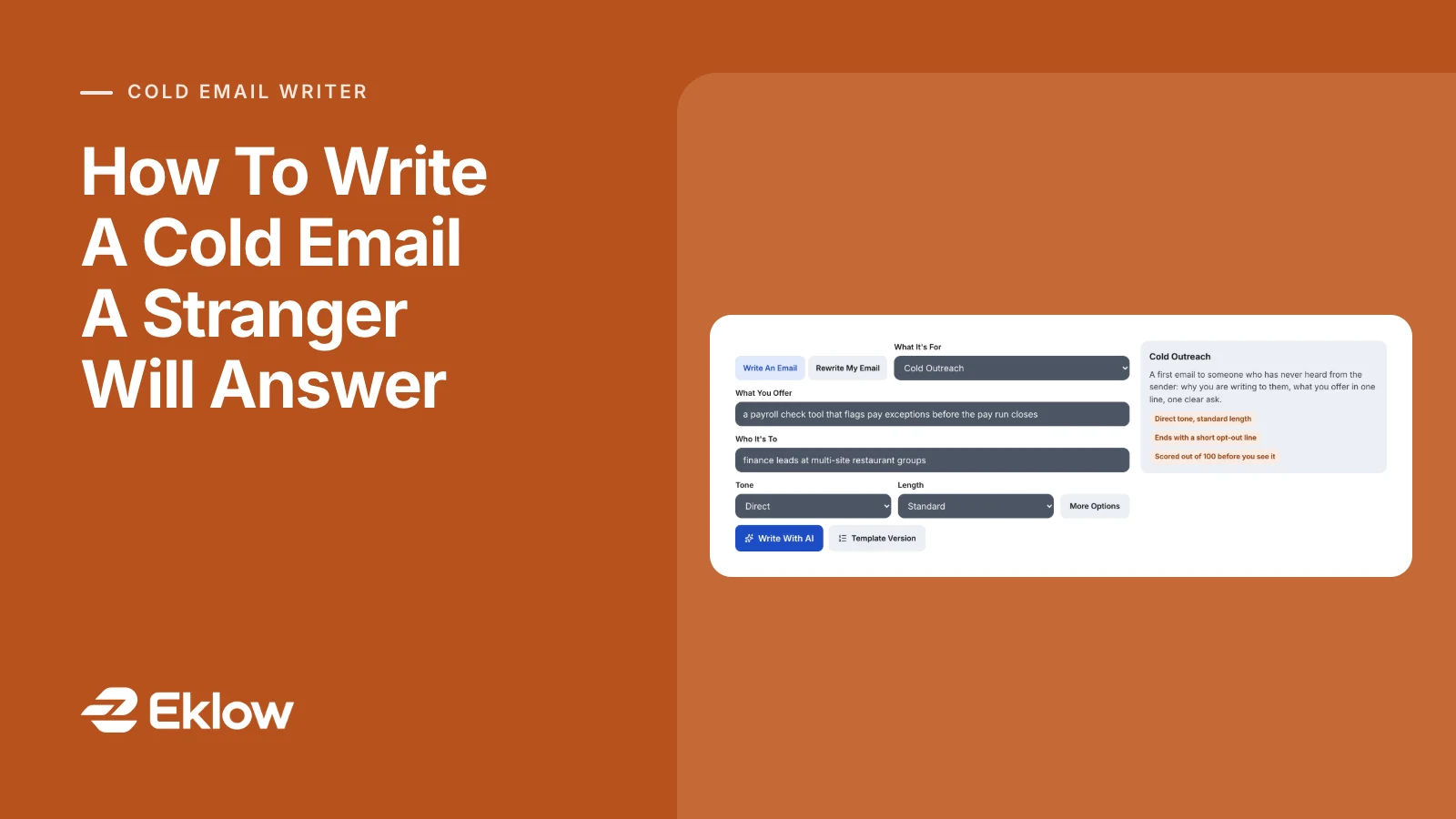
Our free cold email writer is built around the same five parts. Choose Cold Outreach, describe what you offer and who it is for, pick a tone and a length, and it writes a subject line and a body. The short, standard and detailed lengths cap the body at 75, 120 and 160 words, and a short opt-out line is added by default. Anything you want it to say about numbers, customers or prices goes in Facts You Can Stand Behind; it will not add a figure you did not give.
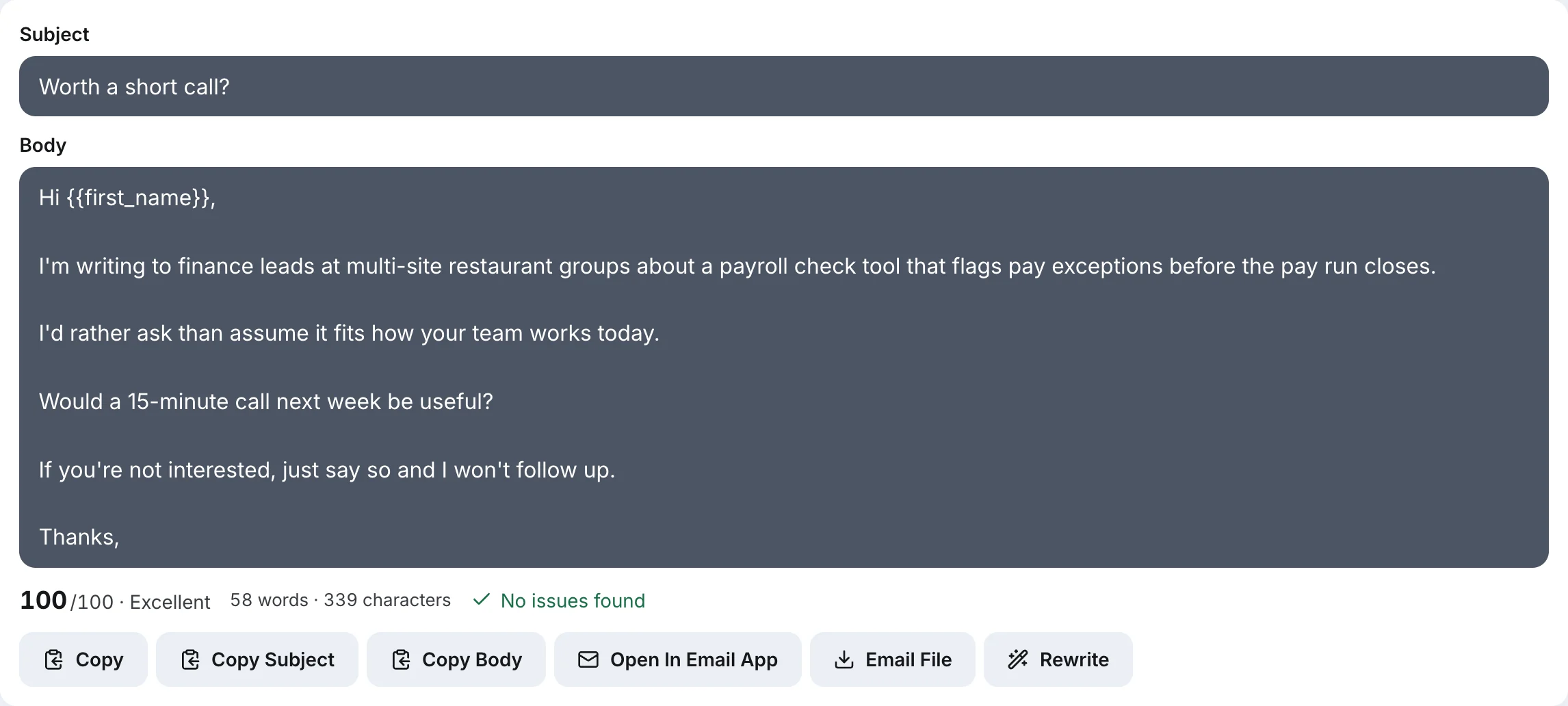
Every version is scored out of 100 by the content checks our email template checker uses, with the word count beside it, so you can see a spam-list phrase, a long subject line or a missing opt-out before you copy anything. You can ask for up to three versions to compare.
When it is ready, Open As Campaign turns the email into a draft campaign in Eklow, with each version as an A/B variant. From there it sends from your own warmed mailboxes inside a sending window, and follow-ups stop when someone replies. How to build a sequence covers adding the next steps.
Keep reading
- Cold EmailSales Email Signature: What To Keep For Cold OutreachA sales email signature for cold outreach should be short, mostly text and light on links. What to keep, what to cut, and why heavy signatures cost you.6 min read
- Cold EmailHow To Respond To Cold Email Replies: Seven AnswersHow to respond to cold email replies: interested, more info, pricing, not now, wrong person, a concern or a no. What each reply means and what to send back.7 min read