


Introduction
You spent an evening on the first email. It named a real problem, it asked for fifteen minutes, and it went to sixty people a week ago. Two answered. The other fifty-eight are a blank, and the draft open in front of you says "Just checking in to see if you saw my email below." You know it adds nothing, so you delete it, and then you are back to an empty reply box.
Here is the short answer. A good follow up email after no response is a short reply in the same thread, sent three or four working days later, that makes answering easier than the first email did. It does that in one of four ways: a smaller ask, one new detail, a different angle on the same problem, or a question someone can answer in a word. It never scolds the reader for not replying, and it keeps the same request rather than inventing a new one. The rest of this guide explains why people go quiet, how to write each kind of follow-up, and which lines to cut.
Why Cold Emails Get No Response
Silence feels like a no, but most of the time it is something more ordinary. Knowing which one you are dealing with tells you what the follow-up has to fix.
- They never really saw it. It arrived during a busy morning, slid below the fold and was never opened again. A follow-up in the same thread brings your first message back to the top with its context attached.
- They saw it, but the ask was too big. "A 30-minute call to walk through your process" is a calendar decision. "Is this a problem for your team?" is a one-word answer. The follow-up can shrink the request.
- It was not clear why it mattered to them. The first email described what you do, not what changes for them. One concrete detail can fix that.
- You wrote to the wrong person. They are not the buyer and do not feel it is their job to redirect you. Asking who owns the problem gives them an easy, helpful reply.
- The timing is wrong. They are mid-quarter, mid-migration or on leave. A follow-up cannot fix this, but a polite close-out can leave the door open for later.
- It landed in spam. If almost nobody replies across a whole list, the copy may not be the problem at all. That is a deliverability question, covered further down.
What A Follow Up Email After No Response Must Add
The test for every follow-up is simple: if the reader opened only this email, would it give them a reason to reply that the first one did not? A bare reminder fails that test. Each of these passes it:
| Type Of Follow-Up | What It Adds | Example Line |
|---|---|---|
| Smaller ask | Lowers the cost of saying yes | "Would a 10-minute look at one week of your jobs be useful?" |
| One new detail | A fact the first email left out | "Dispatchers search by job number, so there is nothing new for drivers to learn." |
| Different angle | The same problem seen from their side | "The cost is not the refund, it is the afternoon someone spends finding the photo." |
| Easy question | A reply that takes five seconds | "Is settling delivery disputes something your team handles, or someone else?" |
| Close-out | Permission to say no or not now | "I'll stop here. If this comes up later, this thread is the place." |
Notice what stays fixed. The problem, the offer and the request are the same from the first email to the last. Only the way in changes. When the ask drifts from a call to a case study to a webinar, the reader learns that nothing here needs a decision, because something different will arrive next week.
How To Follow Up On A Cold Email, Step By Step
- Reply in the same thread. Your first email sits underneath, so you do not have to repeat it. Keep the original subject line.
- Start with the point, not an apology. Skip "Sorry to bother you again" and "I know you're busy." The first sentence should carry the new detail, the smaller ask or the question.
- Add exactly one thing. One fact, one angle or one question. A follow-up that stacks three new points is a second first email.
- Restate the ask, smaller if you can. "Worth a 15-minute call?" can become "Worth a look?" or a yes-or-no question.
- Keep it short. Two to four sentences is plenty. The thread already holds the long version.
- Keep a way out. A plain line such as "If it's not relevant, say so and I won't follow up" turns a silent no into a reply and gives people an alternative to the spam button.
- Sign it the same way. Same name, same mailbox, same signature. A follow-up from a different sender reads as a different conversation.
A Worked Example From One First Email
Here is a first email to dispatch managers at courier companies, followed by three follow-ups written to go after it. The product is fictional; the structure is what matters.
Subject: Proof of delivery disputes

Hi {{first_name}},

When a customer says a parcel never arrived, how long does it take
your team to find the driver's photo?

Docket files every doorstep photo against its job number, so a
dispatcher can pull it up while the customer is still on the phone.

Worth a 15-minute call to see it on a week of your jobs?

Sam
Day 3 (smaller ask)
Hi {{first_name}}, a smaller version of my question: is finding
delivery photos something your dispatchers do by hand today?
Day 7 (one new detail)
Hi {{first_name}}, one detail I left out: drivers keep taking the
same photo they take now. Nothing changes on their side. Would a
short look at one week of your jobs be useful?
Day 13 (close-out)
Hi {{first_name}}, I'll stop here so I'm not filling your inbox.
If disputes become a priority, reply to this thread and I'll pick
it up. And if someone else owns this, a name would help.Each one could be read on its own and still make sense, each one gives a different reason to reply, and none of them changes the request.
Follow-Up Lines That Add Nothing
| Instead Of | Write |
|---|---|
| "Just checking in." | The one new detail, in the first sentence. |
| "Bumping this to the top of your inbox." | A smaller version of the ask. |
| "Did you get a chance to read my last email?" | A question about their situation, not about your email. |
| "As per my previous email..." | Nothing. The previous email is right below. |
| "I haven't heard back, which surprises me." | A close-out that makes silence a fine answer. |
How Long To Wait Before Following Up
Three or four working days before your first follow up email after no response is a sensible default: long enough that it does not feel like pressure, short enough that the first email is still in recent memory. Make later gaps a little longer than earlier ones. A plan such as day 0, day 3, day 7 and day 13 covers about two working weeks. Count working days in the recipient's time zone, so a Friday send does not get followed up on Monday morning as if no time had passed.
For the reasoning behind sequence length and spacing, our guide to sequence design covers it in full. This post is about what goes inside each follow-up.
Rule Out Spam Before You Rewrite Anything
If one or two people in a hundred reply, the copy might need work. If nobody replies across several hundred sends, check where the mail is landing before you write a single follow-up, because a follow-up in the same thread lands in the same place as the first email. An inbox placement test shows whether you reach the inbox at each provider, and SPF, DKIM and DMARC are the first things to confirm when you do not.
Questions About Following Up After No Response
How Many Times Should You Follow Up After No Response?
For a cold prospect, two or three follow-ups after the first email, ending with a close-out, is a reasonable ceiling. Each extra email gives the reader one more chance to mark you as spam, and spam complaints cost more than one missed reply. If people still answer late in the sequence, test one more step; if they do not, stop sooner.
Should I Follow Up If They Opened The Email?
Treat an open as a weak signal at best. Apple's Mail Privacy Protection downloads remote content privately in the background, so a tracking pixel can fire without anyone reading the email (Apple's Mail documentation describes the setting). Follow your planned sequence, and do not write "I saw you opened my email."
Is It Rude To Follow Up On An Unanswered Email?
Not when the follow-up is short, adds something useful and makes it easy to say no. What reads as rude is guilt ("I've reached out several times"), fake urgency, or a follow-up that arrives after the person already answered. Give people a clear way out and stop when they take it.
Should A Follow-Up Use A New Subject Line?
Usually not. Replying in the same thread keeps your first email underneath and saves the reader from piecing the conversation together. A new subject starts a new thread, which can help when the first subject clearly missed, but then the follow-up has to stand alone and carry its own context.
How Eklow Handles This
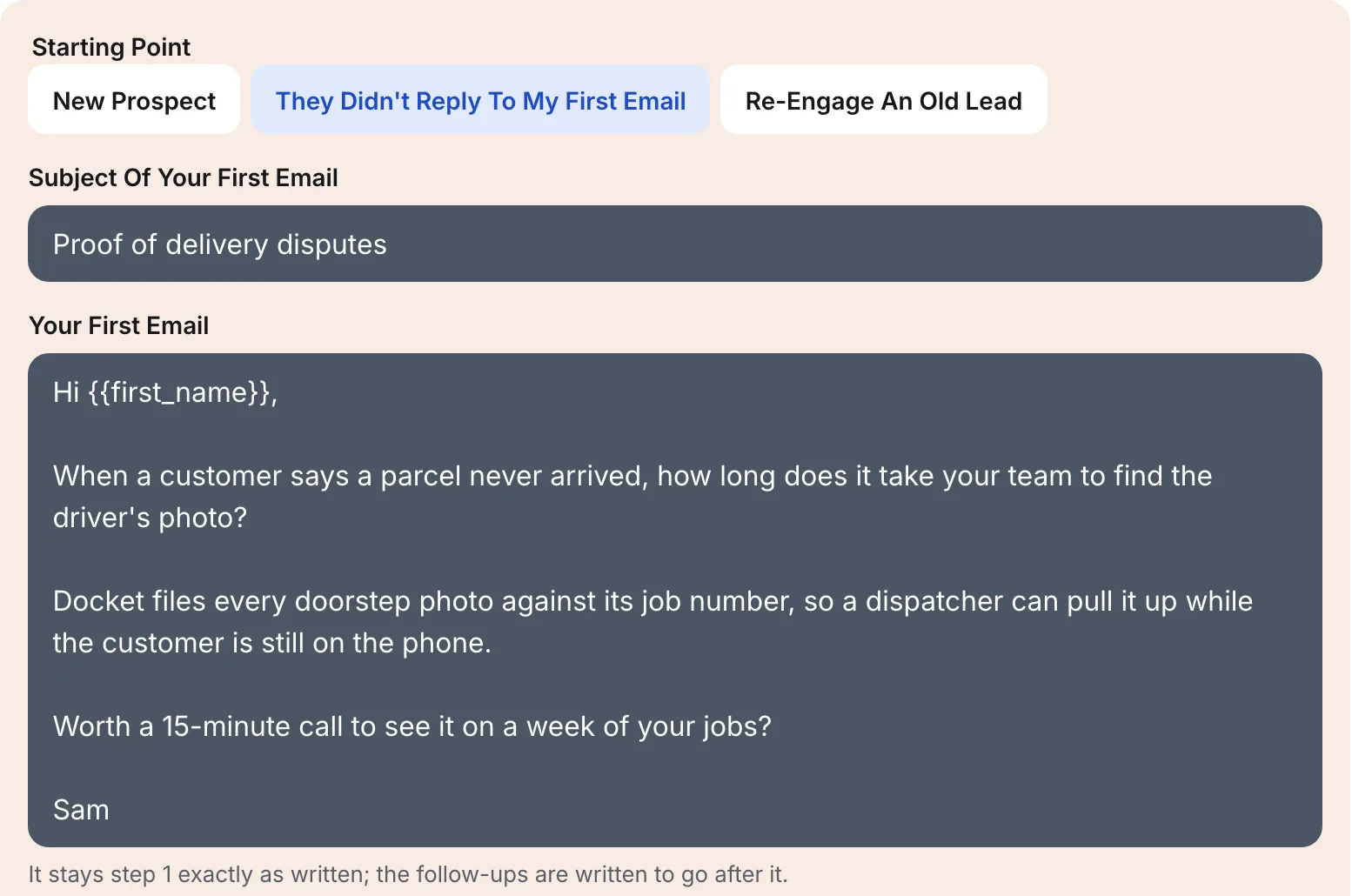
Our free cold email sequence generator has a starting point for exactly this situation. Choose "They Didn't Reply To My First Email", paste the subject and the email you already sent, and it keeps that email as step 1 word for word, then writes the follow-ups to go after it.
Each follow-up has a job: a short follow-up, one that adds a detail, a different angle or an easy question, and a close-out at the end. Follow-ups keep your first subject and are sent as replies in the same thread. Every email is then run through the content checks from our template checker and our subject line rules, and scored out of 100, so a missing opt-out line or a spam-trigger phrase shows up before you send anything.
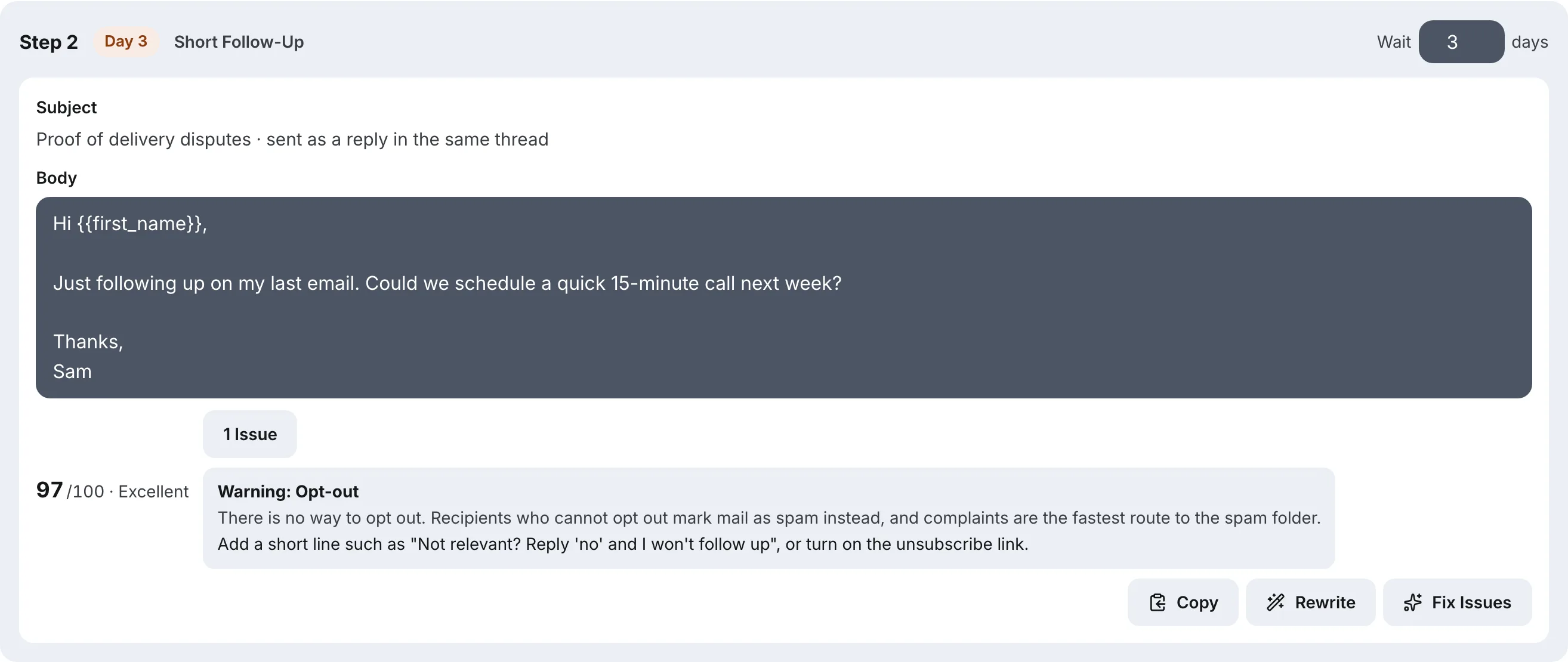
You can edit any email and score it again, change any wait, then copy the sequence, download it, or open it in Eklow as a draft campaign. In a campaign, each wait counts from when the previous email actually went out, sends outside the campaign's sending hours wait for the next allowed time, and a reply from the contact cancels their remaining follow-ups. How to build a sequence covers the steps and delays.
Keep reading
- Cold EmailHow To Write A Cold Email A Stranger Will AnswerHow to write a cold email a stranger will actually answer: the five parts, what each line is for, a worked example, the length that works and what to cut.8 min read
- Cold EmailSales Email Signature: What To Keep For Cold OutreachA sales email signature for cold outreach should be short, mostly text and light on links. What to keep, what to cut, and why heavy signatures cost you.6 min read