


Introduction
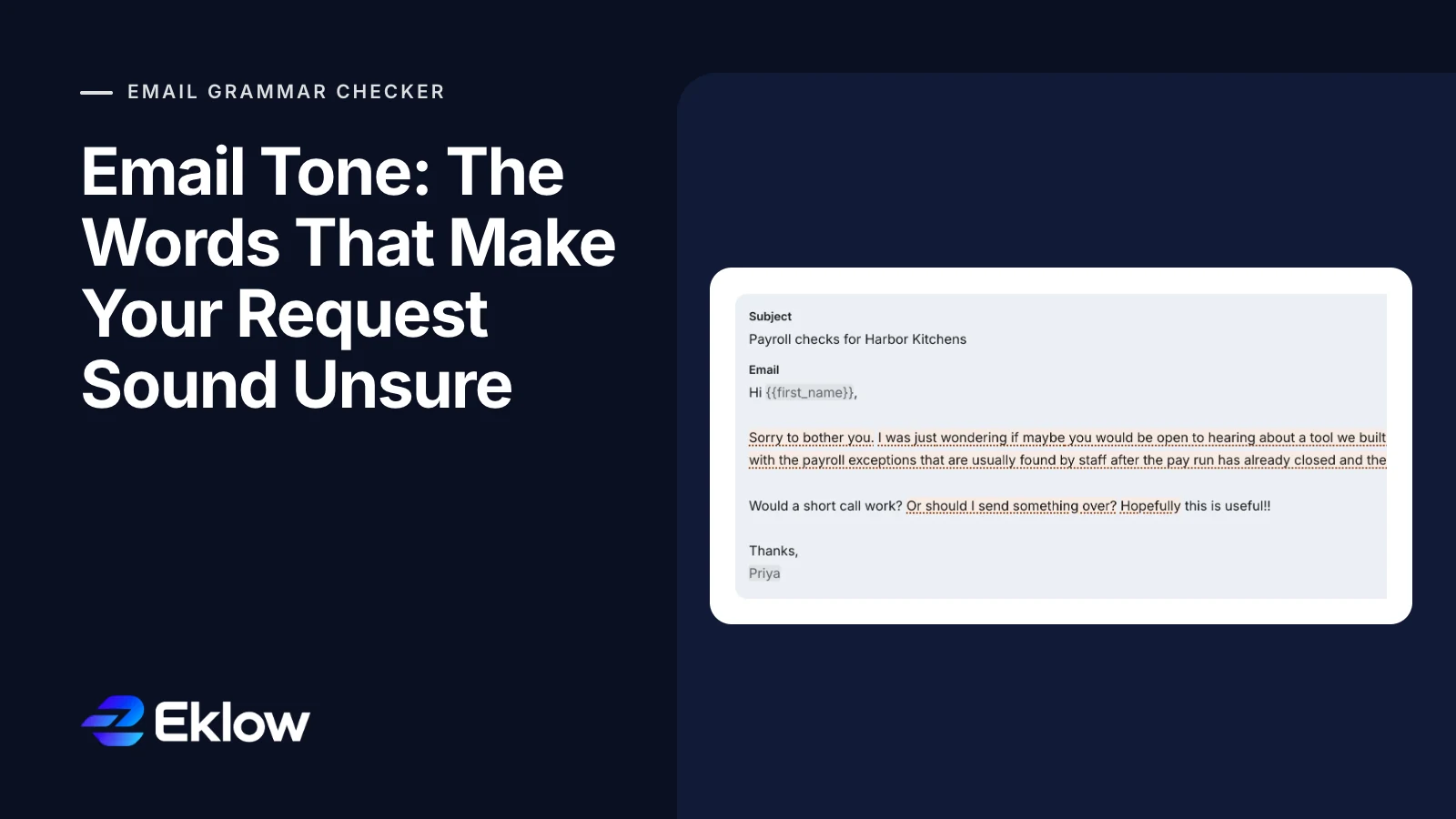
You wrote it to be polite. "Sorry to bother you. I was just wondering if maybe you would be open to hearing about a tool we built, which I think could sort of help your team." Read back the next morning, it sounds like someone apologising for existing. Nobody replied, and it is hard to blame them: the email never said what it wanted with any confidence.
Email tone is mostly made of small, countable habits rather than a mysterious overall feel. Hedging words (just, maybe, I think, sort of, hopefully), an opener that apologises or talks about yourself, passive voice that hides who does what, sentences too long to read on a phone, several questions where one would do, and exclamation marks standing in for warmth. Each one is easy to spot and easy to fix, and fixing them is what makes a request sound clear and confident without sounding pushy. This guide goes through them one at a time with a before and after.
Why Email Tone Goes Wrong
In conversation, your voice and face carry the tone and the words can be loose. In an email the words carry everything, and the reader fills any gap with their own mood. Writers compensate by softening: a "just" here, a "sorry" there, an "I think" before every claim. Each softener is harmless alone. Stacked together, they make a simple request sound unsure, and an unsure request is easy to put off.
The good news is that most of these habits are visible on the page. You do not need a tone score to fix them, and we would be wary of any tool that claims one: there is no reliable method that reads "friendly" or "confident" from text. What you can do is count the specific things that make an email read as unsure, and decide about each one.
Hedging Words: Just, Maybe, I Think
| Hedge | What It Does | Try Instead |
|---|---|---|
| just | Makes the request sound smaller than it is | "I'm writing about…" not "I just wanted to…" |
| I think / I believe / I feel like | Signals doubt about your own point | State it: "This saves a day of corrections" |
| maybe / perhaps | Softens a point you are actually sure of | Keep only where you really are unsure |
| sort of / kind of | Makes the claim vague | Say exactly what it does |
| I was wondering | Turns a question into a story about you | Ask the question directly |
| hopefully | Makes the outcome sound like luck | "This should help" or just say what it does |
Hedges are not always wrong. If you genuinely do not know whether something fits, "this may not fit how your team works" is honest, and honesty reads well. The test is whether you are sure. If you are, say it plainly.
Openers That Apologise Or Talk About You
The first sentence shows in the inbox preview, so it sets the tone before the email is opened. Two openers waste it.
- Apologies and pleasantries: "Sorry to bother you", "I know you're busy", "I hope this email finds you well". They delay the point and, in the apologetic case, tell the reader your email is an imposition.
- Self-focused openers: "I'm the founder of…", "My name is…", "We are a leading…". The reader wants to know why the email concerns them, not who you are, which your signature already says.
Open with the reason for writing instead: "You run payroll for eleven restaurant sites, so pay-run week probably means chasing missing hours by hand." If you want to be warm, thank them at the end.
Passive Voice Hides Who Does What
"The exceptions are usually found by staff after the pay run is closed" makes the reader work out who finds what and when. "Your staff usually find the exceptions after the pay run closes" says the same thing in fewer words, with the people first. The US federal plain language guidelines recommend active voice for exactly this reason. Passive voice is fine when the actor genuinely does not matter ("the report is generated every Monday"); it is a problem when it hides responsibility or adds length.
Long Sentences Read Badly On A Phone
Many recipients read email on a phone, where a 50-word sentence fills the screen and the reader loses the start before reaching the end. The same plain language guidelines advise writing short sentences. A practical rule for email: if a sentence runs past about 30 words, split it where the "and", "which" or "so that" is.
Before:
I was just wondering if maybe you would be open to hearing about a
tool we built, which I think could sort of help your finance team
with the payroll exceptions that are usually found by staff after
the pay run has already closed and the corrections have to be made
by hand.

After:
Your staff probably find payroll exceptions after the pay run
closes, then fix them by hand. We built a check that flags them
before it closes. Worth a 15-minute look?
Too Many Questions And Exclamation Marks
"Would a short call work? Or should I send something over? Or is someone else better placed?" Three questions make the reader choose which one to answer, and the easiest choice is none of them. Ask one. If you need a fallback, put it as a statement: "If someone else owns this, a name would help."
Exclamation marks work the other way. One can read as warm; two or more read as excited or pushy, especially from a stranger. Words in capitals read as shouting unless they are acronyms. Both also appear in spam-filter checks, as our spam trigger words guide explains.
Count You Against I And We
A quick tone check that needs no judgement: count "you" and "your" against "I", "we" and "our". An email with 2 of the first and 11 of the second is about the sender. You do not need to hit a ratio, but if "we" dominates, rewrite a couple of sentences from the reader's side: "we built a check that flags exceptions" becomes "your team sees exceptions before the run closes".
Questions About Email Tone
How Do I Sound More Confident In An Email?
Remove hedges you do not mean, open with the reason you are writing, use active voice, keep sentences under about 30 words, and end with one clear question. Confidence on the page is mostly the absence of softeners, not the presence of strong words. Keep the courtesy (a thank-you, a clear way to say no) and drop the apology.
Is It Rude To Remove "Just" From An Email?
No. "I wanted to follow up" is as polite as "I just wanted to follow up", and clearer. "Just" does not add politeness; it shrinks the request, which can make the reader treat it as optional. Politeness comes from a thank-you and a reasonable ask, not from minimising what you are asking for.
Can A Tool Check The Tone Of An Email?
A tool can count the things that shape tone: hedges, apologetic openers, passive voice, sentence length, questions, exclamation marks and capitals. It cannot reliably label an email "friendly" or "aggressive", because tone depends on the relationship and context. Treat counts as prompts to reread a sentence, not as a verdict.
Should A Business Email Be Formal?
It should match the reader. A first email to a stranger usually reads best as plain and polite, not stiff: full sentences, no slang, no exclamation marks, contractions allowed. Mirror the reader once they reply. If they write two casual lines, a formal page back will feel distant.
How Eklow Handles This
Our free email grammar checker keeps tone notes separate from errors and suggestions, and every note is something it can measure exactly: the hedges in the table above, an apologetic or self-focused opener, passive voice, a sentence over 30 words, a second question, more than one exclamation mark, and words in capitals. Under the result it shows the word count, sentence count, the longest sentence, the number of questions and the count of you against I and we. It never gives a tone score or a label.
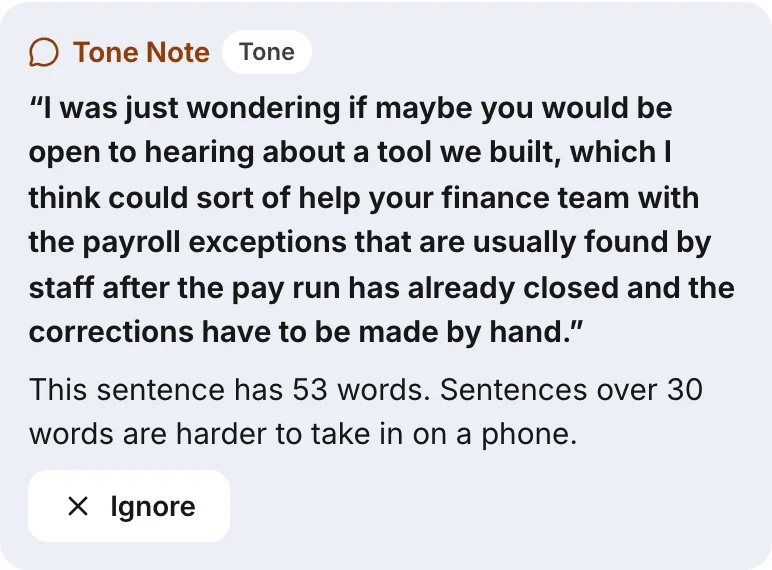
For a sentence flagged for tone, such as a long sentence, passive voice or an opener about yourself, the AI can suggest a rewrite. Each suggestion must keep every merge field, spintax group and link, add no new numbers or names, and pass the grammar rules, or it is not shown, and you accept or ignore it like any other fix. Tone notes and AI rewrites are for English.
When the email is ready, the cold email writer and the sequence editor inside Eklow score it with the same content checks as our email template checker, so the wording is checked for spam-list phrases as well as tone before a campaign launches.
Keep reading
- CopywritingHow To Proofread An Email Before You Hit SendHow to proofread an email in five minutes: names, merge fields, links, the attachment you mentioned, dates and the thread below. A checklist for real slips.7 min read
- CopywritingCommon Email Grammar Mistakes Spellcheck Lets ThroughThe common email grammar mistakes spellcheck never flags: its and it's, then and than, could of, merge fields that break agreement. How to fix each one.7 min read