


Introduction
"Your spam score is 6.2" is a sentence people read without knowing what it means. Is 6.2 high? Out of what? Which part of the email cost the most? The number is useful, but only once you know how it is built.
The short answer: a spam score is the sum of points a rule-based spam filter gives a message for every rule it matches. When the sum reaches the filter's threshold, the message is treated as spam. Lower is better, and the way to lower it is to read which rules fired and remove the cause of the biggest ones.
How A Spam Score Is Built
Most mail servers that run their own filtering use a rule-based filter: hundreds of tests, each worth a number of points, positive for spammy traits and negative for trustworthy ones. The threshold is set by whoever runs the filter, so the one that matters is the threshold printed in the result you are reading, not a number from an article.
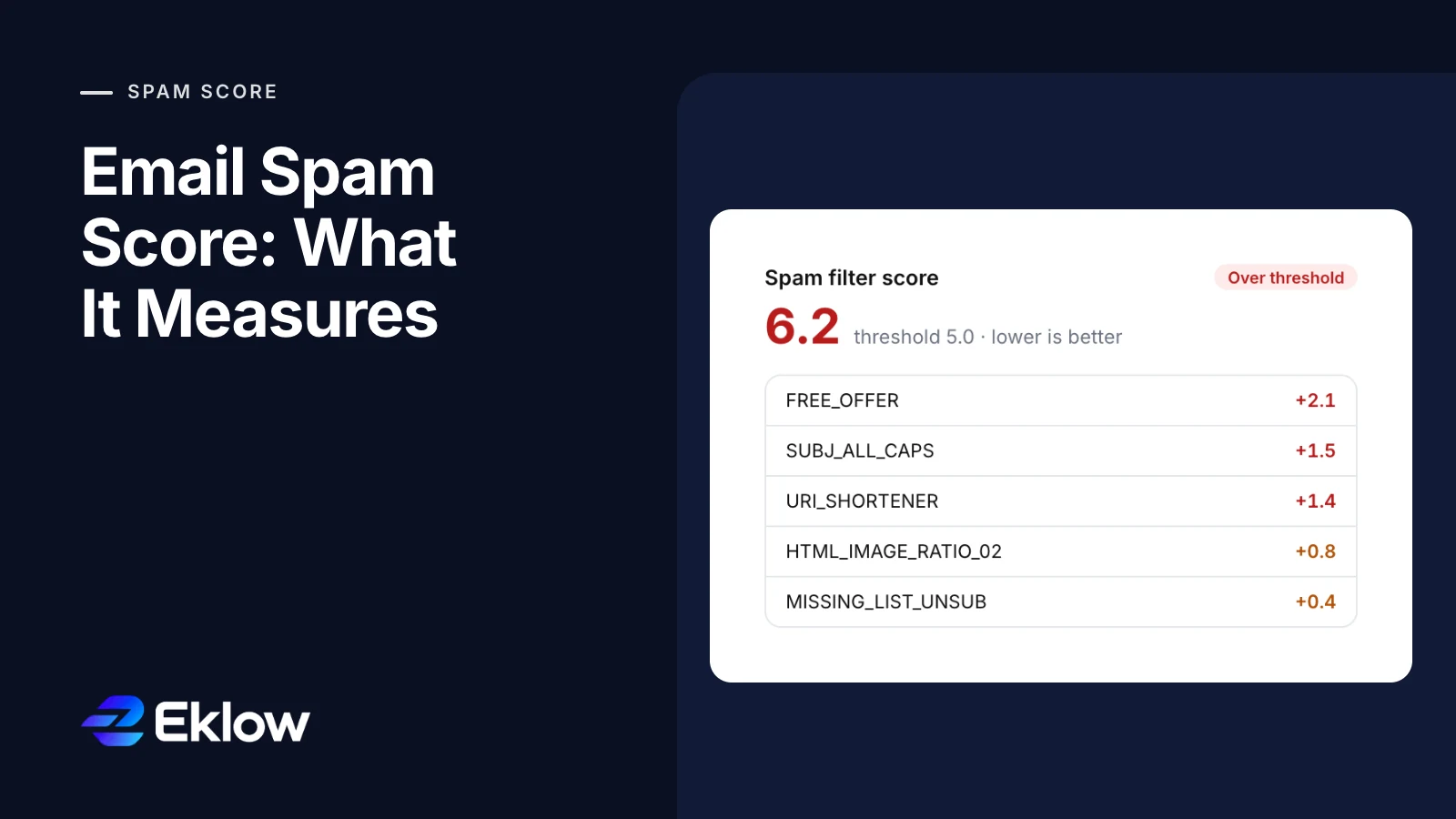
X-Spam-Status: Yes, score=6.2 required=5.0 tests=
    SUBJ_ALL_CAPS=1.5, FREE_OFFER=2.1, URI_SHORTENER=1.4,
    HTML_IMAGE_RATIO_02=0.8, MISSING_LIST_UNSUB=0.4
That example is illustrative: rule names and weights differ between filters and versions. The shape does not. Five rules, none fatal alone, add up to 6.2 and cross the line. Remove the two biggest and the same email scores 2.6.
Spam Score Versus Deliverability Score
Tools often show two different numbers under the same name, which causes most of the confusion.
| Number | Scale | Better is | What it comes from |
|---|---|---|---|
| Spam filter score | Open-ended points against a threshold | Lower | The rules a filter matched |
| Content or deliverability score | Usually 0 to 100 | Higher | A checklist of the subject, body, links, HTML and sender, often with the filter score folded in |
Neither number covers your domain. A perfect email from a domain on a blocklist, or with broken SPF, still struggles. Is my domain hurting my deliverability covers that half.
What Is A Good Spam Score?
Under the threshold passes, but aim well under it. The score you see is one filter's opinion; the receiving server runs its own rules, adds its own reputation data and may be stricter. An email at 4.8 against a 5.0 threshold is one extra rule away from spam on a filter that weighs something slightly differently.
How To Lower A Spam Score
- Sort the rules by points and start at the top. One or two rules usually carry most of the score.
- Rewrite shouting subjects. All capitals, runs of exclamation marks and currency symbols each have rules of their own.
- Replace link shorteners with links to your own domain, and keep links to one or two. Shorteners hide the destination, which is what phishing does (links in cold email).
- Cut the image-heavy layout. A message that is mostly one big image gives the filter little text to judge and trips image-ratio rules.
- Replace pressure phrases such as "100% free", "act now" and "risk-free" with a specific sentence about what you do (spam trigger words in cold email).
- Fill every merge field. An empty
{{first_name}}or a broken placeholder reads as a template to people and to filters. - Check again after each edit, with the final version, not the draft.
What Not To Do
- Do not disguise words (fr3e, F.R.E.E). Filters look for obfuscation itself.
- Do not paste invisible text to dilute the score. Hidden text is a rule in its own right.
- Do not chase zero. A plain, honest email a few points under the threshold beats one rewritten into vagueness.
Spam Score Questions
Can A Spam Score Be Negative?
Yes. Some rules subtract points, for example for valid authentication or a sender on an allow list, so a clean message can score below zero.
Does Gmail Use A Spam Score?
Gmail does not publish a numeric score or threshold. It uses its own filtering and reputation data. A rule-based score is still a useful proxy for the content signals any filter reacts to, but it is not Gmail's verdict.
Why Did The Same Email Score Differently Twice?
Rules are updated, and a few depend on live lookups such as whether a linked domain is on a blocklist. A small change in the email, such as one extra link, can also tip a rule.
How Eklow Handles This
The free Email Spam Score Checker composes your email as a real message, runs it through the spam filter Eklow operates and shows the score, the threshold and every rule that added points. Beside it is a score out of 100 from the same checklist as the Email Template Checker: at or over the filter's threshold, an email cannot grade better than Fair however clean the rest looks. The email is scored in memory and not stored.
Inside Eklow, the template checker runs on every step of a sequence before launch, and keeps a history of each result so you can see whether an edit helped.
Keep reading
- DeliverabilityEmail Throttling For Cold Email: How To Pace Sends Without BurstsEmail throttling explained for cold email: why bursts get rate limited, even spreading versus sending in batches, and why a batch limit should be a sliding window.6 min read
- DeliverabilityIs My Domain Hurting My Deliverability? A Domain Reputation Check, Signal By SignalHow to check your domain's reputation as an email sender: the public signals receivers can see, how to read each one by hand, and what to fix first when your domain is the problem.5 min read