


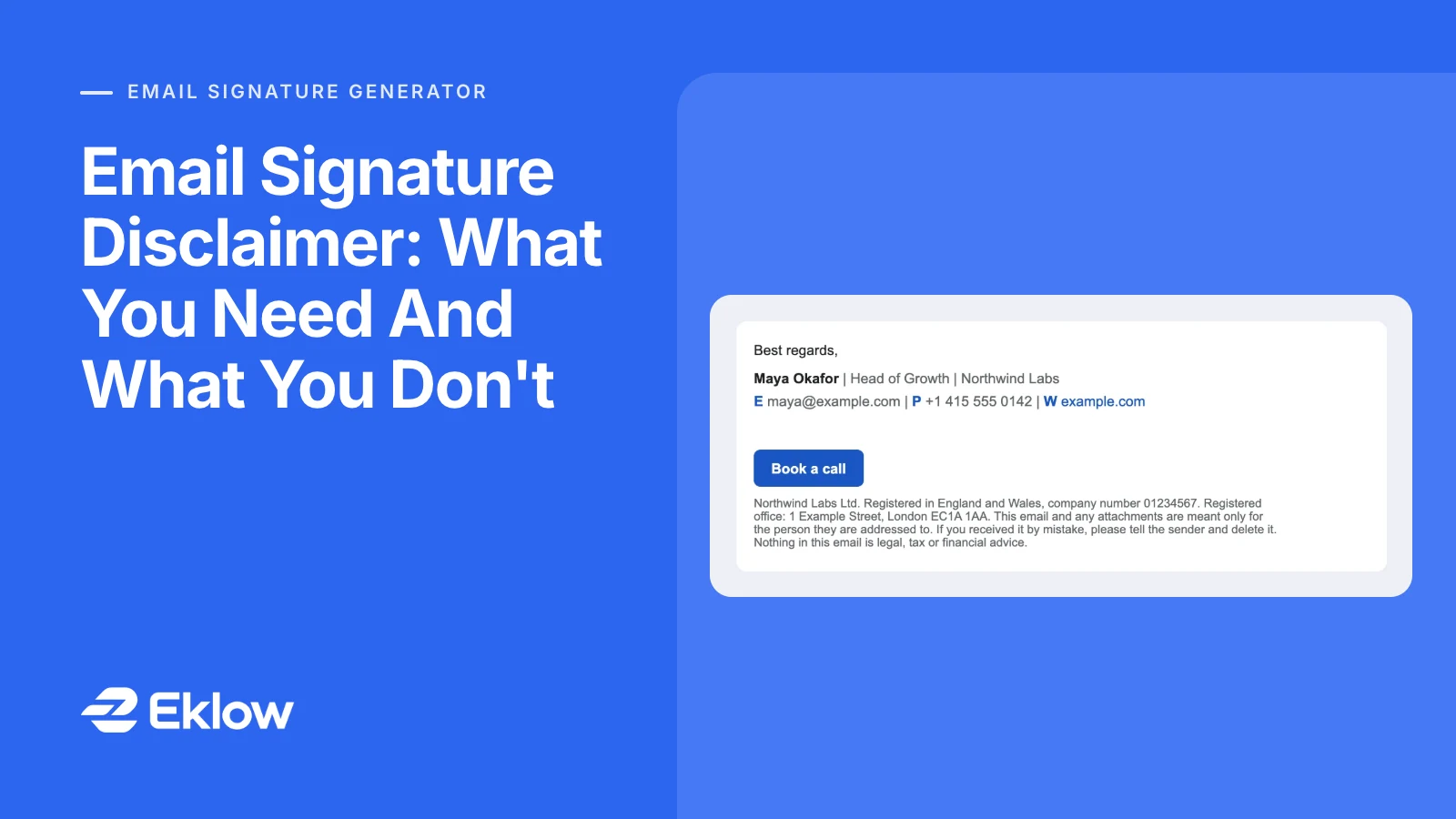
Introduction
Your two-line cold email ends with a nine-line footer: a confidentiality notice, a virus warning, a "think before you print" line, a request to delete the message if received in error and a paragraph about the views of the author not necessarily being those of the company. Legal added it years ago, nobody remembers why, and on a phone the prospect has to scroll past it to find your phone number.
Most email signature disclaimers are not required by any law, and many are of doubtful legal effect. A few lines genuinely are required in some situations: in the UK, a company's registered details on its business correspondence; in the US, a valid postal address and an opt-out in commercial email under CAN-SPAM; and in regulated industries, whatever your regulator specifies. Keep the lines you are obliged to include, write them as briefly as possible, and drop the rest. This guide covers what is required where, what the common boilerplate does and does not achieve, and how to keep the footer short. It is general information, not legal advice; check with your own adviser for your situation.
Why Email Disclaimers Get So Long
Disclaimers accumulate. Each line was added after a scare or copied from another company's footer, and removing one feels riskier than leaving it. The result is a block of text that is often longer than the email, that readers skip, and that makes a personal note look like an automated mailing. For cold outreach in particular, a long legal footer reads as bulk mail before the reader reaches your message.
What The Law Actually Requires
UK Companies: Registered Details
The UK's Company, Limited Liability Partnership and Business (Names and Trading Disclosures) Regulations 2015 require a company to show its registered name on all forms of its business correspondence and documentation (regulation 24). Regulation 25 requires its business letters, order forms and websites to show the part of the UK where it is registered, its registered number and its registered office address. UK trading standards guidance treats business email as covered, which is why UK company footers carry a line like this:
Northwind Labs Ltd. Registered in England and Wales, no. 01234567.
Registered office: 1 Example Street, London EC1A 1AA.
Two lines do the job. There is no requirement to wrap them in a paragraph of other text.
US Commercial Email: Address And Opt-Out
The CAN-SPAM Act applies to commercial email, including business-to-business email. The FTC's compliance guide requires a valid physical postal address in the message and a clear way to opt out, honoured within 10 business days. Neither has to be in a disclaimer as such: the address often sits in the signature, and the opt-out can be one plain sentence at the end of the email.
Not the right person, or not interested? Reply and let me know,
and I won't email you again.
Regulated Industries
Financial services, legal, healthcare and some other sectors have their own rules on what must appear in client communications, such as regulatory status statements. Those come from your regulator, not from general email practice, so use the exact wording your compliance team gives you and nothing broader.
What Common Disclaimers Do And Don't Do
| Disclaimer | What It Is Meant To Do | Worth Keeping? |
|---|---|---|
| Confidentiality notice | Ask a wrong recipient to delete the email | Short version only, if your policy needs it |
| "Not advice" line | Avoid being relied on as professional advice | Only where you could be mistaken for an adviser |
| Views-of-the-author line | Separate personal opinion from the company | Rarely in sales email |
| Virus warning | Shift responsibility for attachments | No; it protects nobody |
| "Think before printing" | An environmental nudge | No; it adds length for no benefit |
| Company registration details | Meet a disclosure law | Yes, where it applies |
| Opt-out sentence | Meet commercial email rules and lower complaints | Yes, for cold outreach |
Confidentiality notices are the most common and the most debated. A footer under a message the recipient has already read cannot undo the disclosure, and whether it creates any obligation for a stranger who received it by mistake depends on the law where you are and the circumstances. We are not aware of a rule that makes such a notice required, and we would not rely on one as protection. If your company policy wants one, keep it to a sentence.
The Right Footer For Cold Email
A cold email should end with your signature and the shortest set of required lines, in that order. In practice that is: name, title and company; one or two contact lines; your postal address if commercial email rules apply and it is not shown elsewhere; any registration details you must show; and one opt-out sentence. Everything else can go. Put the opt-out in every step of a sequence, not only the first; our sequence design guide covers how the steps fit together.
Maya Okafor
Head of Growth, Northwind Labs
+1 415 555 0142 | example.com

Northwind Labs Ltd. Registered in England and Wales, no. 01234567.
Registered office: 1 Example Street, London EC1A 1AA.

Not the right person, or not interested? Reply and let me know,
and I won't email you again.
Where To Put The Disclaimer
At the bottom, below the signature, in smaller text that still meets contrast guidelines. Never as an image: an image cannot be read by recipients who block images or by screen readers, and the information is legally there only if people can read it. Regulation 20 of the UK regulations says required disclosures must be in characters that can be read with the naked eye. In long reply threads, many companies add the full footer only to the first message and new threads, keeping replies short.
Questions About Email Disclaimers
Are Email Disclaimers Legally Binding?
Usually not in the way people hope. A recipient has not agreed to a footer they read after the message, and whether a confidentiality notice has any legal effect depends on the jurisdiction and the circumstances. Required disclosures, such as UK company details, are different: they are obligations on the sender, not terms imposed on the reader.
Is An Email Disclaimer Required By Law?
A general disclaimer is not. Specific information can be: UK companies must show their registered details on business correspondence, US commercial email needs a postal address and an opt-out under CAN-SPAM, and regulated firms may need a status statement. Include those, written briefly, and treat everything else as optional.
How Long Should An Email Disclaimer Be?
As short as the required content allows: usually one to three lines. If the footer is longer than the message above it, readers skip it and the email looks automated. Cut boilerplate first, then shorten the required lines to their essentials, such as the company number and registered office in one sentence.
Do I Need The Disclaimer On Every Reply?
For required company details, the safe reading is that they should be on business correspondence, which includes replies, though many companies keep them only on new messages. For cold outreach, the opt-out sentence should be on every step of a sequence. Ask your adviser if you need a definitive answer for your company.
How Eklow Handles This
Our free email signature generator has a disclaimer field under Extras, with four short starting points: Confidentiality, Not Advice, Printing and Opt-Out. Each is written as one or two plain sentences, and the field takes up to 400 characters, so registration details fit alongside one line of policy text. The disclaimer is added below the signature as text, never as an image.
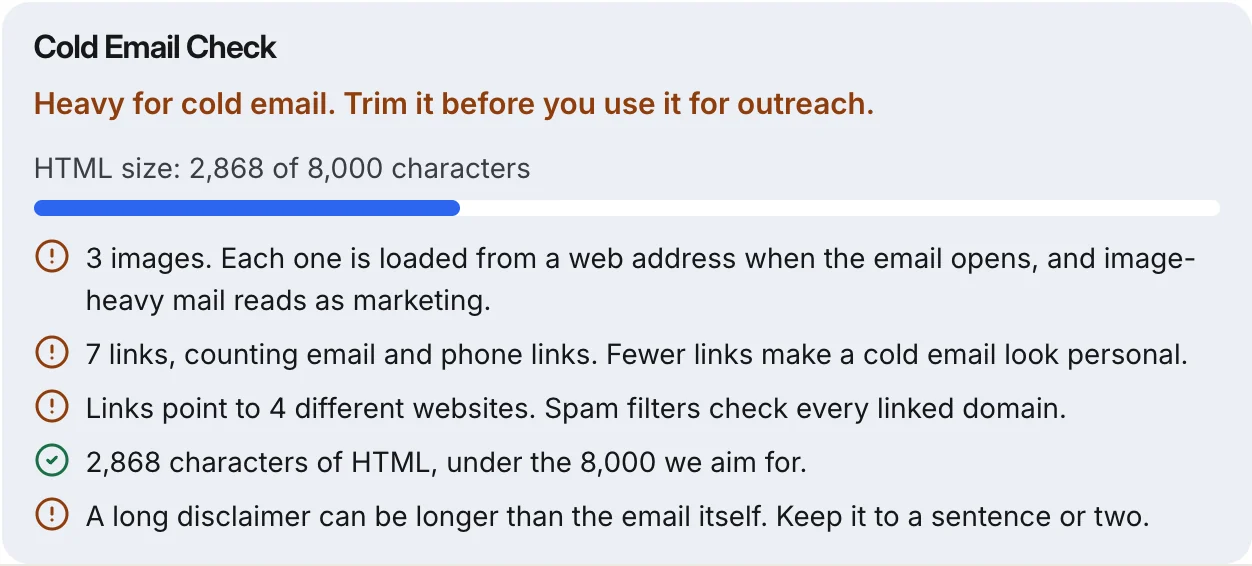
The cold email check under the preview warns when the disclaimer passes 300 characters, because a long disclaimer can be longer than the email itself, and it counts the images, links and linked websites that the rest of the signature adds. Inside Eklow, every campaign message also carries one-click unsubscribe headers, and a signature with its footer can be added to each step with Copy HTML and the step's Raw HTML switch.
Keep reading
- SignaturesOutlook Email Signature Formatting: Why It Breaks And How To Fix ItOutlook email signature formatting breaks because classic Outlook renders mail with Word. Why images stretch and fonts change, and how to build one that holds.6 min read
- DeliverabilityIs My Domain Hurting My Deliverability? A Domain Reputation Check, Signal By SignalHow to check your domain's reputation as an email sender: the public signals receivers can see, how to read each one by hand, and what to fix first when your domain is the problem.5 min read