


Introduction
The clocks change on a Sunday. On Monday your follow-ups to Chicago start arriving at 07:00 instead of 08:00, the shared window your London team uses for New York prospects suddenly opens an hour early, and nothing in your sending tool says anything changed. Two weeks later it fixes itself, or it does not, and you are left guessing which replies you lost.
Daylight saving time breaks email scheduling in one of two ways: the schedule stores a fixed UTC offset instead of a named time zone, or it converts a local time to UTC once and keeps that instant after the offset has changed. The fix is to store every send window as local days and hours in a named zone, such as America/Chicago, and work out each send's moment on its own date. It also helps to know the weeks when different countries are out of step, because those weeks move the gap between cities even when every tool behaves.
Why Scheduled Emails Shift After Daylight Saving Time Changes
A send window means "08:00 where the recipient is". That only stays true if the software keeps the rule, not the arithmetic. Three common shortcuts throw the rule away:
- A fixed offset. The schedule says UTC−5. That is New York in winter and an hour wrong all summer, because the offset itself is what daylight saving changes.
- An abbreviation read as an offset. EST and CST look like zones but most software treats EST as a fixed UTC−5. A window saved as "08:00 EST" runs at 09:00 local from March to November.
- A conversion done once. In October you plan 08:00 New York time, the tool turns it into 12:00 UTC and stores that. After 1 November New York is UTC−5, so 12:00 UTC is 07:00 local, and every remaining send in the sequence arrives an hour early.
The IANA time zone database exists to avoid all three. A name like America/New_York carries every past and future clock change for that region, so software can convert 08:00 on any date to the right instant. The rule to follow is simple: store local time plus a zone name, and convert per send, never per campaign.
Daylight Saving Time Change Dates For 2026 And 2027
The regions most cold email goes to change their clocks on different Sundays, and the Southern Hemisphere moves in the opposite direction. The US dates follow the federal rule NIST summarises (second Sunday in March, first Sunday in November). The EU dates come from Directive 2000/84/EC (last Sunday in March and in October, at 01:00 UTC), and the UK uses the same Sundays. The Australian and New Zealand dates are read from the IANA database.
| Region | Clocks Go Forward | Clocks Go Back |
|---|---|---|
| United States (most states) | 8 Mar 2026, 14 Mar 2027 | 1 Nov 2026, 7 Nov 2027 |
| UK and European Union | 29 Mar 2026, 28 Mar 2027 | 25 Oct 2026, 31 Oct 2027 |
| Sydney, Melbourne, Canberra, Hobart, Adelaide | 4 Oct 2026, 3 Oct 2027 | 5 Apr 2026, 4 Apr 2027 |
| New Zealand | 27 Sep 2026, 26 Sep 2027 | 5 Apr 2026, 4 Apr 2027 |
Plenty of places do not change at all: India, China, Japan, Singapore, Hawaii, most of Arizona, and Queensland and Western Australia among others. Brazil stopped in 2019, which is a reminder that the rules change too, and why a maintained database beats a hand-made table.
The Weeks When The Gap Between Cities Changes
Even with perfect software, the distance between two cities is not constant. New York is normally five hours behind London, but from 8 to 28 March 2026 and again from 25 to 31 October 2026 it is four, because the US and the UK change on different Sundays. London and Sydney are further apart and move more often:
| Dates In 2026 | London | Sydney | Sydney Is Ahead By |
|---|---|---|---|
| 1 Jan to 28 Mar | UTC+0 | UTC+11 | 11 hours |
| 29 Mar to 4 Apr | UTC+1 | UTC+11 | 10 hours |
| 5 Apr to 3 Oct | UTC+1 | UTC+10 | 9 hours |
| 4 Oct to 24 Oct | UTC+1 | UTC+11 | 10 hours |
| 25 Oct to 31 Dec | UTC+0 | UTC+11 | 11 hours |
This matters whenever you schedule one window for several places in a single zone. A London window that overlaps New York's morning in most weeks opens an hour earlier for New York during the out-of-step weeks, and a window planned against Sydney in June is two hours off by December.
Times That Happen Twice Or Not At All
On the spring change in the US, clocks jump from 02:00 to 03:00, so 02:30 local time does not exist that night. On the autumn change they fall from 02:00 back to 01:00, so 01:30 happens twice. Software handles these moments differently: some moves the send forward, some sends it twice, some refuses it. The simple protection is to keep send windows inside working hours, where no clock change ever lands.
Send Window Pitfalls Beyond Daylight Saving
The clock change is the famous scheduling bug, but a send window has a few quieter ones. All of them come from the same idea: the window is evaluated in the recipient's time, not yours.
- Weekend launches wait. A Monday to Friday window launched on Saturday sends nothing until Monday morning in each recipient's zone. The campaign is running; it is just waiting for the window.
- Days belong to the recipient. Monday 08:00 in Sydney is Sunday 21:00 in London (in November). A Monday to Friday window in Sydney time means your mail leaves on Sunday evening by your own clock, which is correct.
- Queued sends keep their times. Many schedulers fix each message's send moment when it is queued. Change the window afterwards and the messages already queued may keep their old times, so set the window before launch.
- Holidays are not weekends. A window that knows Saturday and Sunday still sends on a national holiday. Pause the campaign or skip the region that day.
A Manual Check Before Each Clock Change
- Open each active campaign's schedule and confirm the time zone is a named zone, not an offset or an abbreviation.
- Look up the change dates for every region on the list, using the table above or the IANA data.
- For any campaign scheduled in one zone for several regions, recheck the shared hours for the out-of-step weeks.
- After the change, compare the first few sends' local arrival times with the window. An hour's drift points to a stored offset or a one-time conversion.
Questions About Daylight Saving And Scheduled Email
Do Scheduled Emails Adjust For Daylight Saving Time?
Only if the scheduler stores a named time zone and converts each send on its own date. Then 08:00 stays 08:00 local through the change. If it stores a fixed offset, an abbreviation read as an offset, or a UTC time converted once, sends after the change arrive an hour early or late.
When Do The Clocks Change In 2026?
In the US they went forward on 8 March 2026 and go back on 1 November 2026. In the UK and the EU they went forward on 29 March and go back on 25 October 2026. In south-east Australia they went back on 5 April and forward on 4 October 2026.
Which Countries Don't Use Daylight Saving Time?
Many, including India, China, Japan, Singapore and Brazil, which stopped in 2019. Within countries that do use it, some regions opt out, such as Hawaii and most of Arizona in the US and Queensland in Australia. The IANA time zone database records which regions change and when.
What Happens To An Email Scheduled In The Skipped Hour?
It depends on the software: some shift it to the next valid minute, some send it at the matching UTC instant, and some reject it. Rather than rely on any of them, keep send windows inside working hours. Clock changes happen in the small hours, so a working-day window never touches them.
How Eklow Handles This
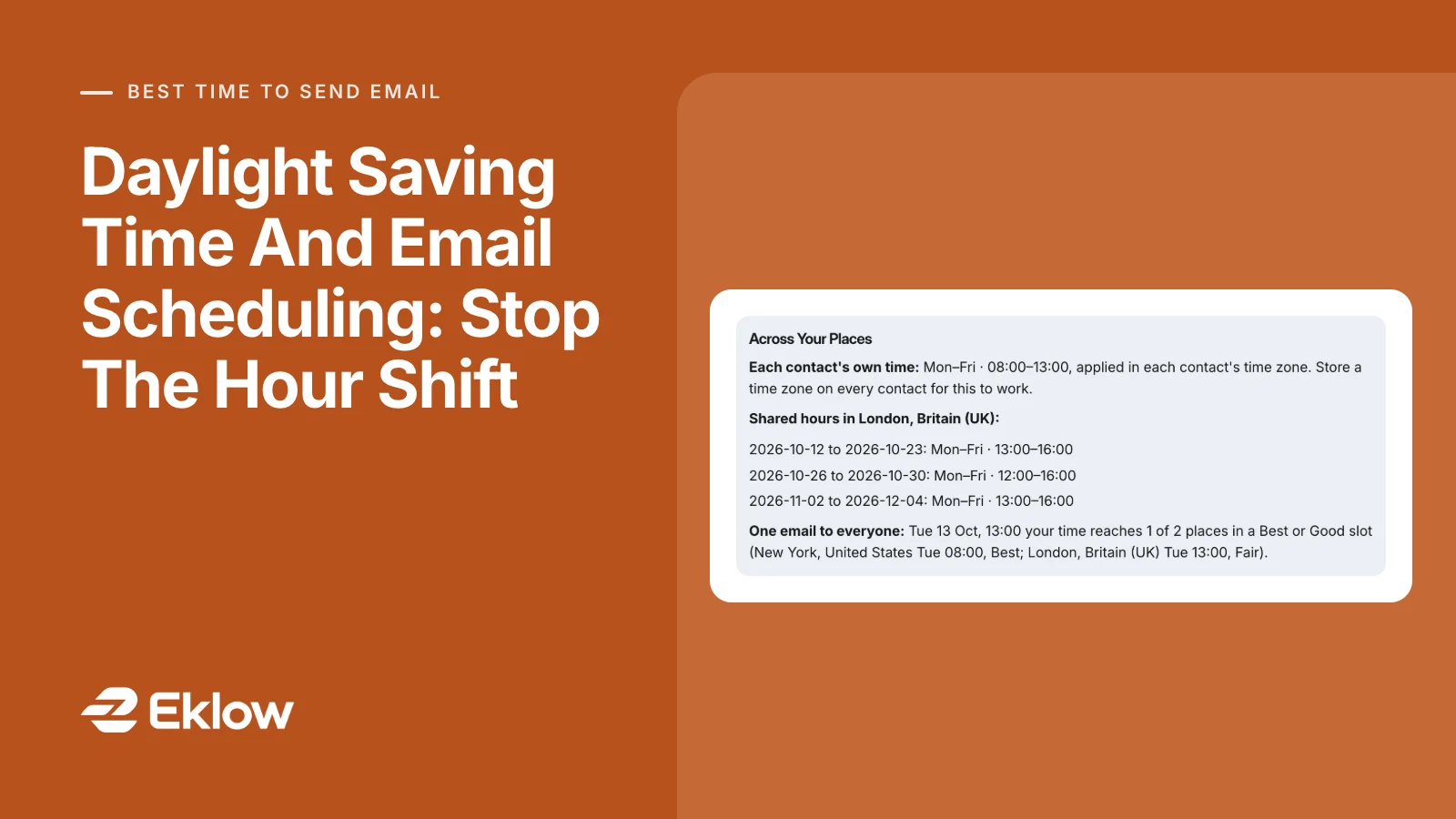
Our free best time to send email calculator works on real dates rather than today's offsets. Plan New York prospects in a London campaign and it lists the shared hours with the dates they apply, so the out-of-step week in October shows up as its own line.

An Eklow campaign window is stored the way this guide recommends: sending days, a start and end time, and a named time zone. Each send's moment is worked out from the contact's zone on that day, so 08:00 in Chicago stays 08:00 in Chicago on both sides of a clock change. A zone written as EST is read as America/New_York, summer time included, rather than as a fixed UTC−5.
Before you launch, the Review & launch tab states the window and the moment the first email will go out. Launched on a Sunday, a Monday to Friday campaign says so plainly:

Messages already queued keep the send time they were given, so set the window before launching. How scheduling windows work covers the settings, and if you are ramping new mailboxes across a clock change, the warmup ramp schedule explains why steady daily volume matters more than the exact hour.
Keep reading
- Cold EmailHow To Write A Cold Email A Stranger Will AnswerHow to write a cold email a stranger will actually answer: the five parts, what each line is for, a worked example, the length that works and what to cut.8 min read
- Cold EmailSales Email Signature: What To Keep For Cold OutreachA sales email signature for cold outreach should be short, mostly text and light on links. What to keep, what to cut, and why heavy signatures cost you.6 min read