


Introduction
You have a clean list, a warmed mailbox and an email you rewrote four times. Then you stare at the subject field for twenty minutes, paste in something from a swipe file, and watch the campaign go quiet. Nobody replies, and you cannot tell whether the line looked like spam, like a pitch, or simply like nothing at all.
Good cold email subject lines are short, specific statements of why you are writing to this one person, in plain sentence case, with nothing the email itself does not back up. The best source for one is your own reason for reaching out, not a list of lines that worked for someone else. Below are five patterns that turn a real reason into a subject, the rules from Google and the FTC that every line has to meet, and the habits that make an honest line read like spam.
Why Borrowed Subject Lines Stop Working
A line copied from a list of examples was written for someone else's reader, offer and moment. Pasted onto your email it is either vague ("Quick question") or wrong ("Loved your podcast episode" when the prospect has no podcast). Vague lines give the reader no reason to open; wrong ones break trust before the first sentence. And because thousands of senders copy the same lists, the reader has usually seen the line before.
There is a second cost. A subject line is a promise about the message under it. Google's email sender guidelines say the subject, headers and display name should accurately represent the sender and the message content, and the FTC's CAN-SPAM guide puts it as a legal requirement in the US: the subject line must accurately reflect the content of the message, and the law makes no exception for business-to-business email. A borrowed line that promises something your email does not deliver fails both.
How To Write Cold Email Subject Lines From Your Reason For Writing
Before you write a single subject, finish this sentence in your own words: "I am writing to this person because…". Say it about one reader, not a segment. For a company that matches purchase orders to carrier invoices, writing to an operations lead at a distributor, it might be: "Their team checks freight bills by hand, and I can show them a month of invoices matched automatically in fifteen minutes."
Every honest subject line is a short cut of that sentence. You pick one part of it (the reader's problem, what you noticed, the reader's role, the ask) and say it in five to eight words. The patterns below are just the different parts you can lead with.
Five Subject Line Patterns, With Examples
| Pattern | Leads with | Example | Honest only when |
|---|---|---|---|
| Reason | Why you are writing | Freight bill checks at Harbor Supply | Your email is about exactly that |
| Observation | Something you noticed about them | Your second warehouse in Tacoma | You really saw it, and the email says where |
| Question | The problem, as a question they can answer | Who checks carrier invoices at Harbor Supply? | The email asks the same question |
| Role | The job the reader does | For the person who signs off freight invoices | They are that person, as far as you know |
| Plain ask | What you want from them | 15 minutes on your carrier invoices? | The email asks for those 15 minutes |
Write one line in each pattern, then read them next to your email's first sentence. The best one is usually the line the email answers most directly. If the email opens with the Tacoma warehouse, lead with the observation; if it opens with the ask, the plain ask is the honest choice.
B2B Cold Email Subject Lines For Meeting Requests
A meeting request is where subjects drift into pressure: "Can we chat this week?", "Following my calendar invite", "Time-sensitive". Name the meeting and what it is about instead, and keep any duration you can stand behind. "20 minutes on outbound reporting" tells a busy head of sales the size and the topic. "Your Q4 pipeline review" claims there is a review on their calendar; unless there is, it misrepresents the message.
- Honest: "A 15-minute look at your freight invoices" when the email offers exactly that.
- Honest: "Question about Harbor Supply's carrier audits" when the email asks it.
- Misleading: "Re: our call" when there was no call. Google's guidelines rule out Re: and Fwd: on anything that is not a real reply or forward.
- Misleading: "Your invoice is ready" on a sales pitch. It imitates a transaction to get the open.
What Makes An Honest Subject Line Look Like Spam
A truthful line can still be written in a way filters and readers associate with bulk mail. These are the habits our subject line tester flags, each tied to a rule in a widely used open-source spam filter, a provider guideline or our own spam-phrase list:
- Words in capitals. "FREIGHT BILLS" reads as shouting and matches filter rules on capitalised subjects.
- Repeated punctuation, and a question mark together with an exclamation mark. One question mark is fine.
- A dollar amount at the very start, as in "$4,000 back on freight". Move the number later or leave it for the email.
- Gappy text such as "F r e e" or odd spacing, a trick filters look for.
- Phrases from spam lists. Our spam trigger words guide explains why context matters more than single words.
- A reply or forward prefix on a first email, in any language.
Length is the other trap. A phone cuts the subject to fit one line, and on a narrow screen that can be well under 50 characters. Put the words that carry the reason first, so "Freight bill checks at Harbor Supply" survives even if the end is cut.
How To Write And Test A Batch By Hand
- Write your reason sentence for one real prospect, not the segment.
- Draft one subject in each of the five patterns above.
- Cross out any line the email does not answer in its first two sentences.
- Read the rest aloud. Cut capitals, extra punctuation, and any word you would not say to the reader in person.
- Check how each line looks on a phone, and move the important words to the front.
- Send two finalists to two halves of the same list and compare replies, not opens, once each half has enough sends to mean something.
Questions About Writing Subject Lines
How Long Should A Cold Email Subject Line Be?
Short enough that the important words show on a phone. There is no official limit to aim for, because each phone and mail app shows a different number of characters. Five to eight words usually covers a specific reason, and putting the key words first means a cut end costs you little.
Should I Put The Prospect's Name In The Subject Line?
Only if the line still reads well without it and the field is filled for every contact. A first name alone is not a reason to open; the company or something you noticed usually says more. If you use a merge field, give it a fallback, so a blank field never leaves a broken line.
Are Question Subject Lines Good For Cold Email?
A question works when the reader can answer it and your email asks the same thing. "Who checks carrier invoices at Harbor Supply?" invites a one-line reply. A rhetorical question such as "Want more pipeline?" does not, and reads like an advert. Keep it to one question mark.
Should Subject Lines Be Lowercase In Cold Email?
Sentence case is the safe choice: a capital at the start and on names, the rest lowercase, the way people write to each other. All lowercase is a style choice some senders like. Title Case on every word looks like a newsletter, and whole words in capitals match spam filter rules.
How Eklow Handles This
The free email subject line generator starts where this guide does: with your reason for writing. You describe the email in a sentence or two, say who it is for and pick a tone.
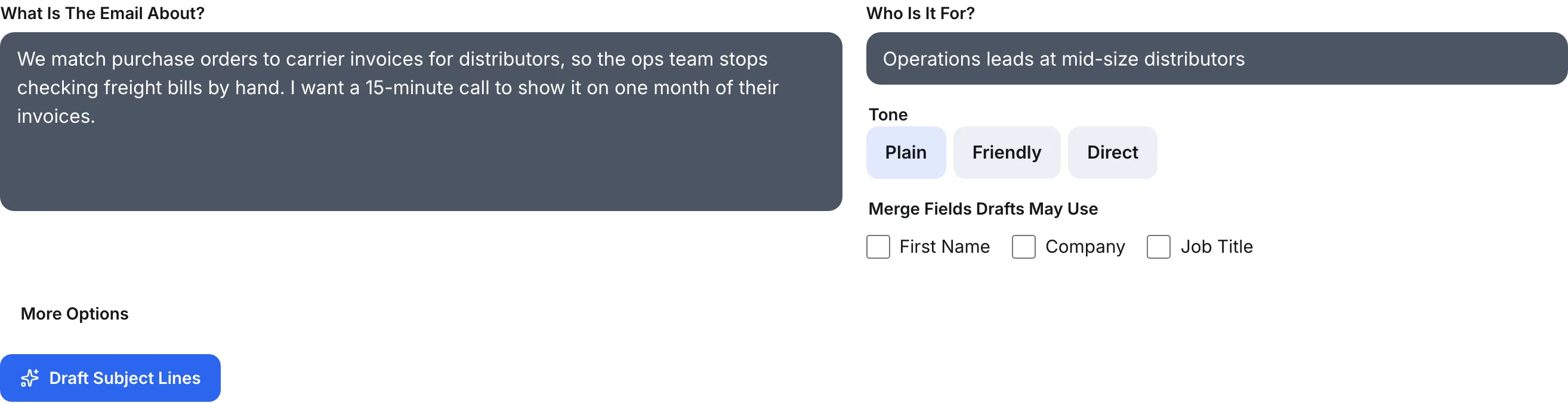
SpirenAI, Eklow's AI, drafts subject lines with preview text from that brief, and every draft then runs through the same checks as our subject line tester. A draft with a spam-list phrase, capitals, a fake reply prefix, or a number or name that is not in your brief is left out, and the result says how many were dropped. In the run below, five drafts passed and one did not.
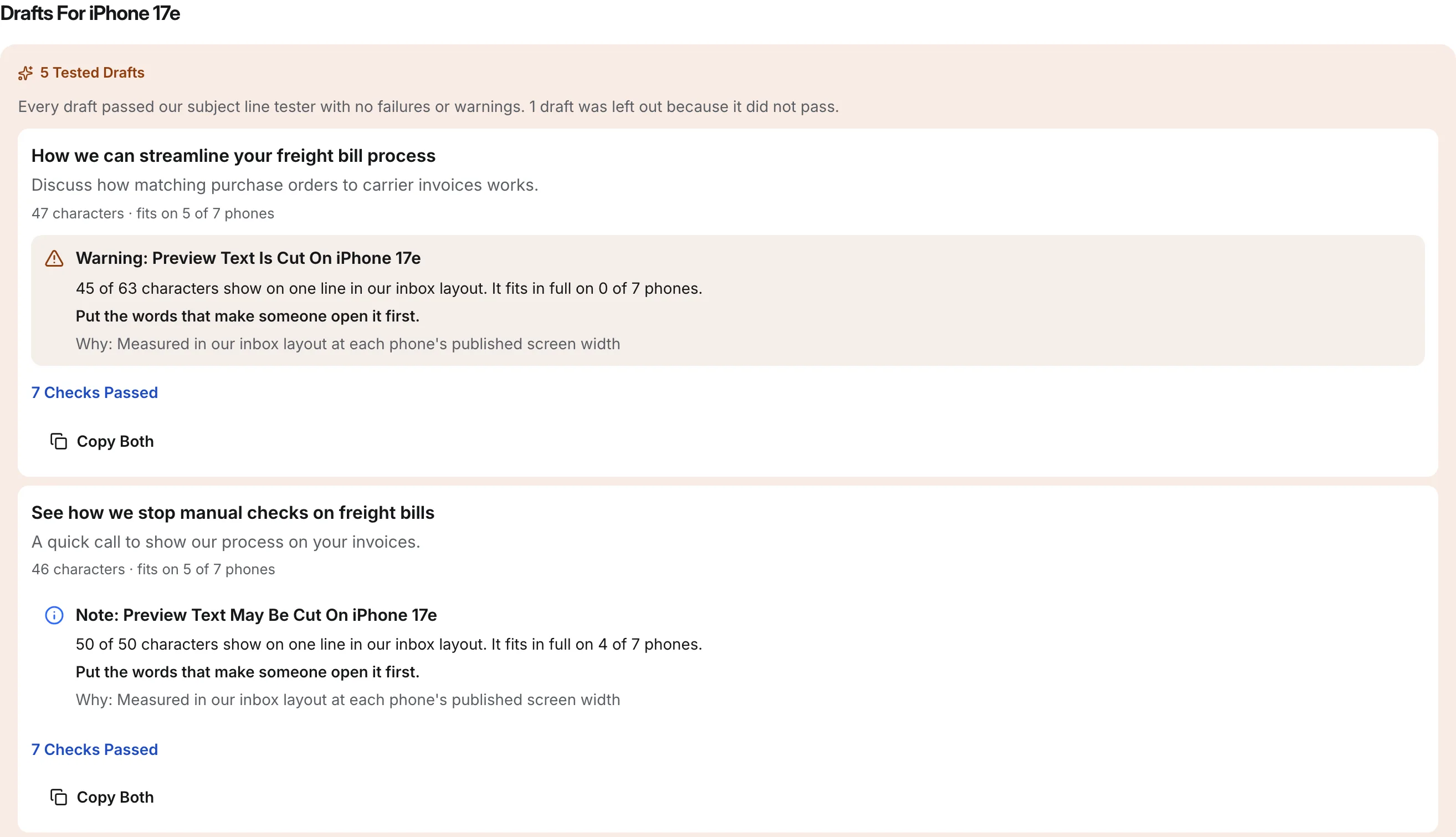
Treat the drafts as a starting point, not a final answer. In this run "See how we stop manual checks on freight bills" is close to a reason line, while "How we can streamline your freight bill process" talks about us rather than the reader and would be the first one we edit. The generator never adds a figure or a company name you did not give it, so a vaguer brief gives vaguer lines.
Inside Eklow, you can add subject line variants to a sequence step, and the campaign splits contacts between them so you can compare replies. The guide to building a sequence shows where variants live, and testing your template for spam covers the rest of the email before you launch.
Keep reading
- Cold EmailHow To Write A Cold Email A Stranger Will AnswerHow to write a cold email a stranger will actually answer: the five parts, what each line is for, a worked example, the length that works and what to cut.8 min read
- Cold EmailSales Email Signature: What To Keep For Cold OutreachA sales email signature for cold outreach should be short, mostly text and light on links. What to keep, what to cut, and why heavy signatures cost you.6 min read