


Introduction
Your sequence ends on day 13, and the last email is the one you rewrote four times. The version you found online says "I'm guessing you're not interested, so I'll close your file." It felt bold in the draft. Sent, it got one sarcastic reply, one "please remove me" and, you suspect, a few clicks on the spam button you will never see.
Here is the short answer. A breakup email is the final message in a cold email sequence. It tells the prospect you are going to stop writing, makes "no", "not now" and "wrong person" as easy to send as "yes", and leaves the thread open for later. It is two to four sentences, sent as a reply in the same thread, with no guilt and no invented deadline. Then you actually stop. This guide covers why the guilt-trip version backfires, what each line of a good sales breakup email is for, three original templates, and when to send it.
What A Breakup Email Is For
A breakup email has three jobs, and none of them is to shame someone into a meeting.
- Close the loop honestly. You promised yourself a sequence of four emails. Saying "this is my last note" is simply true, and it tells the reader the follow-ups will not continue indefinitely.
- Collect the replies that were waiting for permission. Some people meant to answer "not this quarter" or "talk to my colleague" and never got round to it. A close-out invites exactly those replies, and they are useful: a date to come back, or the right name.
- Leave a good last impression. The last thing a prospect remembers about you is this email. A polite one costs nothing. A pushy one can turn a quiet no into a spam report, and spam reports are counted against your domain.
Why The Guilt-Trip Close Backfires
The classic breakup template leans on pressure: "Should I close your file?", "Did I do something wrong?", "I've reached out five times and heard nothing." The idea is that the fear of missing out pushes a reply. The trouble is who receives it. A stranger who never asked for your emails owes you no explanation, and a message that implies they do reads as passive aggression.
That matters beyond manners. Gmail asks bulk senders to keep the spam rate reported in Postmaster Tools below 0.10% and never to reach 0.30% (Google's email sender guidelines). Yahoo sets the same 0.3% line in its sender best practices. Those are small numbers. A last email that annoys even a handful of people on a few hundred sends moves you toward them, and the cost lands on every campaign that uses the same domain.
Our sequence design guide makes the same point briefly in its section on step four. Here is the longer version, with the parts spelled out.
Anatomy Of A Sales Breakup Email
| Part | Its Job | Example Line |
|---|---|---|
| Acknowledge without blame | Name the silence as normal, not as a failing | "Looks like the timing isn't right, which is completely fine." |
| Say you'll stop, and mean it | Make the end of the sequence explicit | "I'll stop writing about this after today." |
| One line of value | Remind them what the thread is about | "In short: payroll exceptions caught before the pay run closes." |
| Easy exits | Give three cheap replies: yes, later, wrong person | "If it's useful later, reply here. If someone else owns payroll, a name helps." |
| Same sign-off | Keep it recognisably the same sender | "Thanks, Priya" |
Leave out what does not serve those jobs: attachments, new links, a full restatement of the pitch, a calendar link pushed as the only option, and anything that starts a new topic. It is the shortest email in the sequence, not the longest.
Breakup Email Templates To Adapt
Three originals, each built for a different last impression. Swap in your own offer and keep the length.
The Plain Close
Hi {{first_name}},

I haven't heard back, so I'll take it that payroll checks aren't a
priority right now, and I'll stop writing about it.

If catching exceptions before the pay run closes becomes useful
later, reply to this thread and I'll pick it up.

Thanks,
Priya
The Right-Person Close
Hi {{first_name}},

This is my last note on this. If payroll checks across your sites
sit with someone else, I'd be grateful for a name and I won't
write to you again about it.

Either way, thanks for reading.

Priya
The Not-Now Close
Hi {{first_name}},

I'll stop here so I'm not crowding your inbox. If the timing is
the issue rather than the idea, a one-word reply with a month
("March") is enough and I'll come back then, not before.

Thanks,
Priya
Each template gives the reader a way to answer in a few words, none of them asks for a call in full again, and none of them pretends an offer is about to expire.
When The Prospect Went Quiet After A Meeting
A prospect who took a call and then went silent is not a cold contact any more, so the close can be warmer and more specific. Refer to what you discussed, name the one decision that is open, and offer to step back: "When we spoke you were waiting on budget for next year. I'll leave it with you; if it gets approved, reply here and I'll send the plan we talked about."
When To Send The Last Follow-Up Email
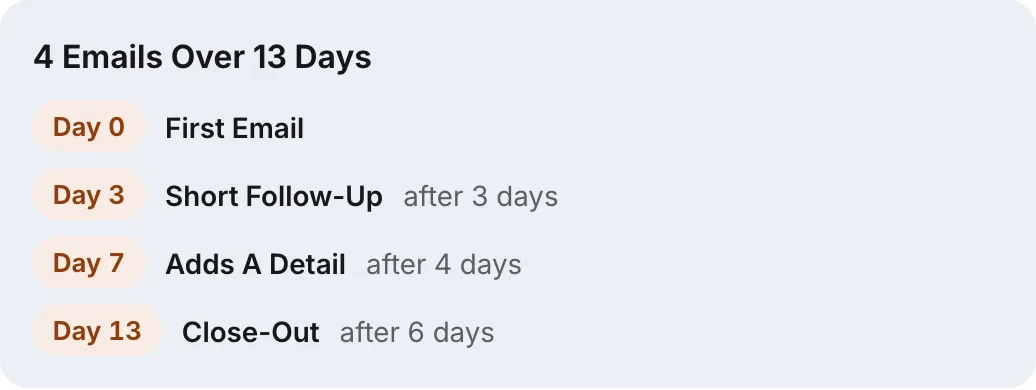
Send it as the final step of the sequence you planned, not as an extra one. In a four-email sequence that is step four, typically a little later than the gap before it, so the whole sequence ends around two weeks after the first email. Send it in the same thread so the earlier emails sit underneath, and keep the original subject line. A dramatic new subject such as "Breaking up?" starts a new thread and reads like a marketing stunt.
Then honour what the email said. If you wrote "this is my last note", do not drop the same person into another sequence next week. Come back only with a genuinely new reason, such as a new role, a product change that matters to them, or a month they named themselves.
Questions About Breakup Emails
Do Breakup Emails Work?
There is no trustworthy public figure for how many replies this kind of email earns, and claims you see are usually one company's own data. What is clear is the mechanism: it collects replies from people who meant to answer and gives others a polite way out. Measure it yourself by tagging replies by step.
Is A Breakup Email Unprofessional?
Not if it is short, honest and free of guilt. Telling someone you will stop writing is a courtesy. What reads as unprofessional is the theatrical version: threats to "close your file", sad-face jokes, or implying the reader was rude for not answering an email they never asked for.
What If They Reply "Not Interested"?
Thank them in one line and stop, including any other campaigns that might reach them. Do not argue or ask why unless they invited it. A clean "Thanks for letting me know, I won't write again" is the reply most likely to be remembered well if their situation changes later.
Should The Last Email Have A New Subject Line?
Usually not. Keeping it in the same thread means the earlier emails sit underneath, so the reader has the context for a one-line reply. A new subject on the last email starts a fresh thread and makes it look like a new campaign rather than the end of one.
How Eklow Handles This
Our free cold email sequence generator always ends a sequence with a close-out, whether you choose two emails or seven. The AI is told to write the last email as a polite close that stops the sequence and leaves the door open, with no guilt or pressure. With the default opt-out setting, every email carries a plain opt-out line, and on the last one it reads "If you're not interested, no reply is needed and this is my last note."
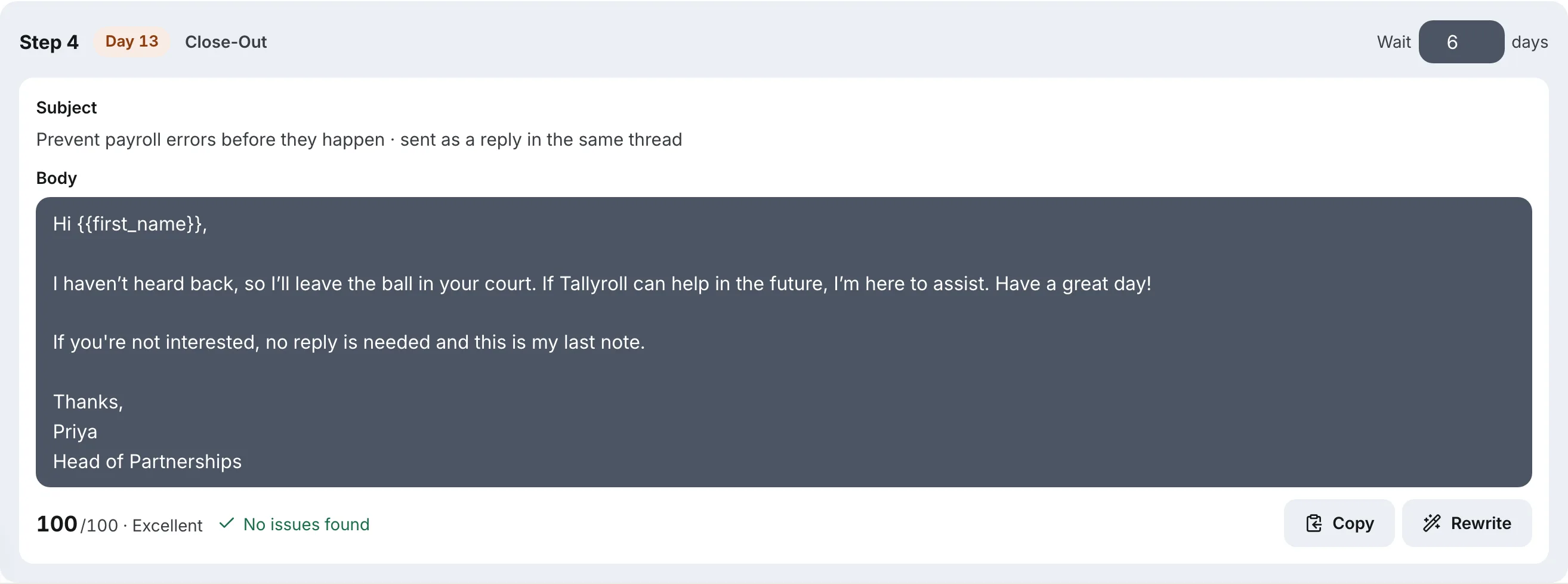
Every email is checked with our template checker's content checks and our subject line rules before you see it. If a close-out says something like "feel free to reach out", the checker flags "free" as a spam-trigger phrase so you can reword it. The plan beside the form shows where the close-out falls before anything is written.
Open the sequence in Eklow and it becomes a draft campaign. After the last step nothing else is scheduled for that contact, and if they answer the close-out, the reply lands in your Inbox as a conversation. With stop on reply on, which is the default, a reply at any earlier step cancels the close-out too, so nobody gets a "this is my last note" after they have already answered. How to build a sequence covers steps, delays and stop on reply.
Keep reading
- Cold EmailHow To Write A Cold Email A Stranger Will AnswerHow to write a cold email a stranger will actually answer: the five parts, what each line is for, a worked example, the length that works and what to cut.8 min read
- Cold EmailSales Email Signature: What To Keep For Cold OutreachA sales email signature for cold outreach should be short, mostly text and light on links. What to keep, what to cut, and why heavy signatures cost you.6 min read