


Introduction
You read three guides on timing. One said Tuesday at 10, one said Thursday at 8, one said Wednesday afternoon. You moved your sequence to Tuesday mornings, waited a month, and the reply rate looked exactly like it did before. Now you have a fourth article open and no way to tell which of them describes your prospects.
Here is the short answer. The best time to send cold emails is the start of the prospect's working day, on a day they work, in their own time zone: roughly from an hour before they sit down until two hours in. Past that, no published study can hand you a universal hour, because the studies disagree with each other for reasons you can name. The rest of this guide covers those reasons, what stays true whichever study you trust, and how to run a send-time test on your own list that gives you an answer you can act on.
Why Best Time To Send Cold Emails Studies Disagree
Most timing studies come from a sending platform or an agency looking at its own customers' mail. That is real data, but it answers a narrower question than the headline suggests. Six things make two honest studies reach different winners:
- Different audiences. An agency booking meetings with US software founders and a recruiter writing to hospital managers in Germany are measuring different people with different days. A pooled average describes neither of them.
- Opens are not reads. Apple's Mail Privacy Protection downloads remote content privately in the background when a message arrives, not when someone looks at it (Apple's Mail documentation describes the setting). A tracking pixel fired that way records the delivery time, so any study ranked on opens partly measures when mail was sent.
- The data follows the senders' habits. If most of the mail in a study went out on weekday mornings, mornings have the most data and the steadiest numbers. Hours that few people send at look noisy and rarely win, whatever they would do with more volume.
- Whose clock is recorded. A send logged as 09:00 in the sender's zone reached Los Angeles at 06:00 and London at 14:00. Unless the study converts every send to the recipient's local time, its "9 am" is a mix of very different moments.
- Mixed sequence steps. First emails and follow-ups behave differently, and follow-ups land on whatever day the gap puts them. Counting them together blurs the day-of-week picture.
- Small gaps and large noise. Cold email reply rates are low, so a difference of a fraction of a percentage point between two days needs a very large sample before it means anything. Rankings built on gaps that small can flip from one year to the next.
None of this makes the studies useless. It means their shared pattern (weekday mornings, recipient's time) is more trustworthy than any specific hour or day they crown.
What Holds Whichever Study You Trust
Strip away the rankings and a few mechanics remain that do not depend on anyone's dataset. They are enough to pick a sensible cold email send time before you have any results of your own.
The Recipient's Working Day Decides
A work inbox gets triaged when its owner starts the day. Mail that arrives just before that moment is near the top of the pile; mail that arrived at 2 am sits under everything that came in since. So the useful question is never "what time is it for me?" but "when does this person start work, where they are?" A prospect in Chicago who starts at 08:30 and one in Singapore who starts at 09:00 need two different send times from the same campaign.
The Best Day To Send Cold Emails Depends On Their Week
Middle-of-the-week advice assumes a Monday to Friday week, and not everyone has one. The Unicode CLDR, the reference data most software uses for calendars, records Friday and Saturday as the weekend in countries such as Kuwait, Oman and Jordan. Mail sent on a Thursday afternoon there lands at the end of someone's week. Public holidays matter the same way: a Tuesday that is a national holiday is a weekend day for your purposes.
Within a working week, the first and last days carry a catch-up and a wind-down load. That is a reasonable judgment rather than a measured law, and it is why it makes sense to prefer the middle days without holding a campaign for a week to hit one.
Morning Or Afternoon For B2B Cold Email Timing
Early in the working day is the default because of the triage habit above, not because afternoons fail. If your buyers spend mornings in operations meetings, on site visits or on shift handovers, their first quiet moment at a desk may be after lunch. Your own replies are the only evidence that can overrule the default, which is what the next section is for.
How To Test Your Own Cold Email Send Time
A send-time test is a split test where the only thing that changes is the window. Everything else has to stay fixed, or you end up measuring the copy or the mailbox instead of the hour.
| Keep The Same | Change |
|---|---|
| Copy, subject line and sequence steps | The send window, in the recipient's local time |
| Mailboxes and daily volume per mailbox | Nothing else |
| List source and segment, split at random | Only one window per arm |
| Calendar weeks the test runs over | Run both arms over the same weeks |
- Pick two windows worth comparing, for example 08:00 to 10:00 against 13:00 to 15:00 in each prospect's time.
- Split one list at random into two halves. Do not split by company size or region, or the halves differ before the test starts.
- Send the same sequence to both halves from the same mailboxes over the same weeks, so holidays and news hit both arms equally.
- Measure replies, and positive replies if you tag them. Leave opens out for the reason above.
- Run full weeks, and keep going until each arm has enough sends that a gap between them would be hard to explain as chance. With low reply rates that usually means hundreds of sends per arm, not dozens.
- If one window wins clearly, make it your default and test the next question, such as the best day. If neither wins, the hour was not your bottleneck; the list or the message is.
Questions About Cold Email Send Times
Should You Send Cold Emails On Weekends?
For business prospects, usually not. A weekend send waits under the Monday pile and reaches people on a day they did not plan to work. The exceptions are buyers whose working week includes the weekend, such as retail, hospitality or countries where Sunday is a working day. Check the recipient's week before deciding.
Does Sending On Monday Morning Bury Your Email?
It can, because Monday mornings carry everything that arrived over the weekend. That is a reason to prefer the middle of the week, not a ban on Mondays. A short, specific email still gets read on a Monday, and waiting a week to avoid one costs more than the small difference it might make.
How Long Should A Send Time Test Run?
At least two full weeks, and longer if your volume is low. Both arms need enough sends that the gap in replies is bigger than chance would produce, which with typical cold email reply rates means hundreds of sends per arm. Stop early only if something is broken, such as bounces or a delivery problem.
Should I Use My Time Zone Or The Prospect's?
Always the prospect's, because their working day decides when the email gets read. A campaign scheduled in your own zone sends to every region at a different local hour, which is the same mixing problem that makes timing studies disagree. Store a time zone on each contact and schedule the window in local time.
How Eklow Handles This
Our free best time to send email calculator works from the mechanics above rather than from anyone's benchmark. You choose the email type and where your recipients are, and it grades each 15-minute slot of their week as Best, Good, Fair or Avoid from their working hours and working days. For a first cold email, Best runs from an hour before the workday until two hours into it, and the first and last working days of the week are graded one step lower.
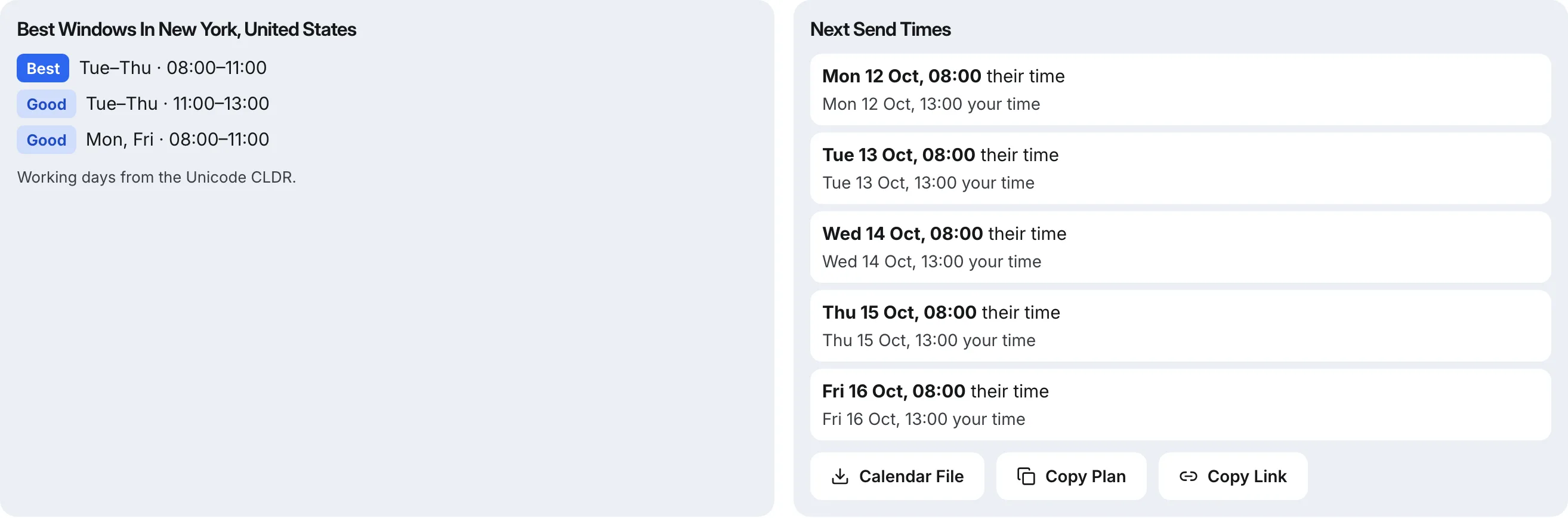
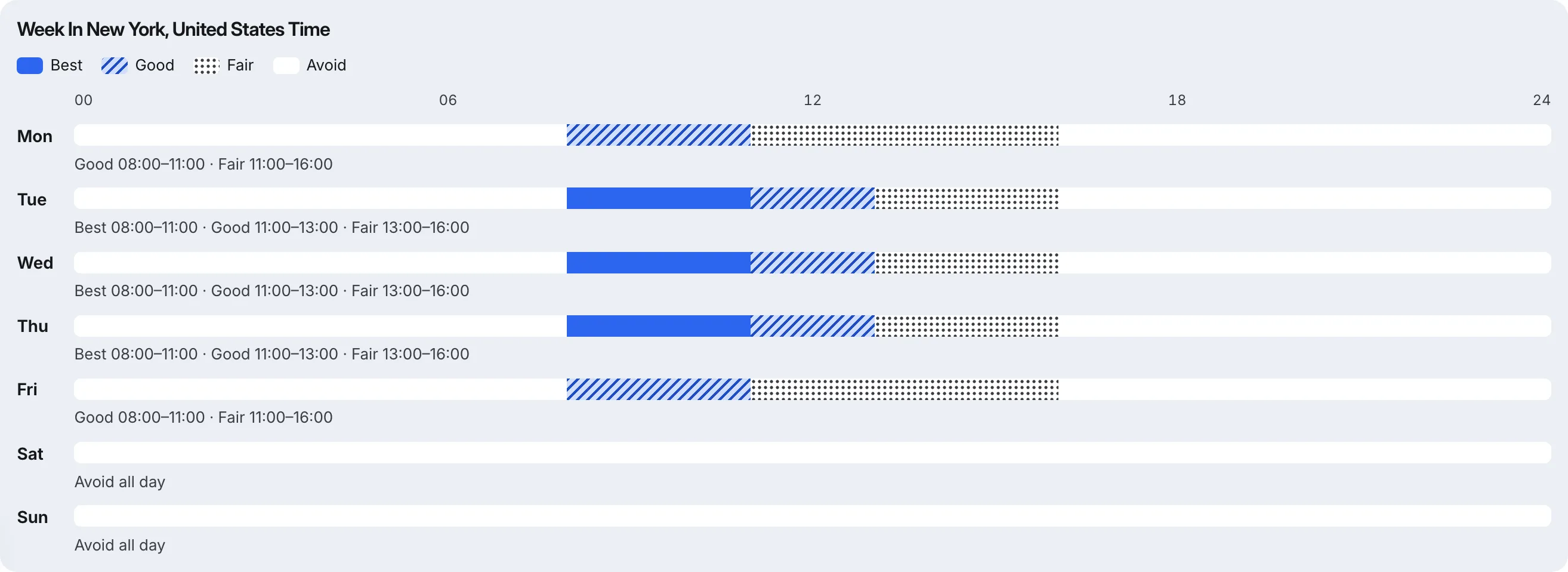
The week view shows why: Tuesday to Thursday mornings are Best, Monday and Friday mornings are Good, and the weekend is Avoid. Working days come from the Unicode CLDR, with corrections where the CLDR differs from local office practice, and you can edit any day or hour that does not match your buyers.
In Eklow, a campaign's sending days and hours apply in each contact's own time zone when the contact has one, so one 08:00 to 11:00 window reaches Chicago and Singapore at their own 8 am. The calculator's "Use This Window In A Campaign" button carries the days, hours and zone into a campaign schedule. To test two windows, split a list into two random halves and give each campaign its own window; how scheduling windows work covers the settings.
Timing is the last thing to tune, not the first. If replies are flat at every hour, read the deliverability metrics that matter and how to design a short sequence before moving the window again.
Keep reading
- Cold EmailHow To Write A Cold Email A Stranger Will AnswerHow to write a cold email a stranger will actually answer: the five parts, what each line is for, a worked example, the length that works and what to cut.8 min read
- Cold EmailSales Email Signature: What To Keep For Cold OutreachA sales email signature for cold outreach should be short, mostly text and light on links. What to keep, what to cut, and why heavy signatures cost you.6 min read