


Introduction
The draft took eight seconds. It opened with "I came across your recent post on scaling operations and loved your insights", claimed your product helps teams "cut onboarding time by 43%", and closed with "Best regards, [Your Name]". You never read their post, you have never measured onboarding time, and you only noticed the placeholder after 200 copies had gone out.
That is the real problem with AI cold email: not that a model wrote it, but that nobody checked what it made up. An AI writing tool fills every gap in your brief with something plausible, and in sales email the plausible gap-fillers are exactly the things that lose trust: an invented statistic, a meeting that never happened, a compliment about content the sender never saw, and filler phrases every other AI draft also uses. The fix is to brief the tool with facts, forbid it from adding any, and check each draft against a short list before it goes anywhere near a send button.
Why AI Cold Email Drafts Fail
A language model writes the most likely next words for the request it was given. Ask for "a cold email for my payroll tool" and the most likely cold email contains a personal opener, a number, a benefit and a meeting request, because that is what cold emails usually contain. If you did not supply the opener, the number or the benefit, the model supplies typical ones. They read fluently, which is what makes them dangerous.
Invented Facts And Statistics
"Teams like yours save 12 hours a week" sounds specific, and specificity is persuasive. If the figure is not yours, it is a false claim made in your name. A prospect who asks "where does 12 hours come from?" ends the conversation you were trying to start. In the US, the FTC's CAN-SPAM guide also bans deceptive subject lines and header information, and general truth-in-advertising rules apply to the body too.
False Premises: The Meeting That Never Happened
"Great chatting at the conference", "Following up on our call", "I loved your podcast episode". Models produce these because warm emails often start that way. In a cold email they are false, the reader knows they are false, and a fake Re: or Fwd: in the subject line makes the same lie in the inbox. Filters and people both treat a fake reply prefix as a trick, because it is one.
Placeholders And Notes Left In
[Company], [Your Name], "Insert a relevant case study here", markdown asterisks around a bold phrase, or a line such as "Note: you may want to add a specific metric". Each one shows the reader exactly how the email was produced. When drafts are pasted into a sending tool in bulk, one leftover placeholder goes to every contact.
Filler Words Everyone Else Uses
Drafts from general-purpose AI tools lean on a recognisable vocabulary: "boost", "supercharge", "revolutionise", "discover how", "explore", "optimise your workflow", "in today's fast-paced world". None of these words is banned by any filter. The problem is that prospects now receive several such emails a week, and the shared vocabulary marks yours as one more of them before they reach the offer.
How To Brief An AI Email Writer Properly
Most of the damage is prevented before the draft exists. A good brief replaces the gaps the model would fill with your own facts.
- Say who it is for in their terms. "Finance leads at restaurant groups with several sites" beats "decision makers".
- Say what you offer as an outcome. "Flags pay exceptions before the pay run closes" beats "payroll platform".
- List the facts it may use, and only those. Customer count, setup time, price floor, one named integration. If a fact is not on the list, it must not appear.
- Forbid what you cannot back. No statistics, no customer names, no past contact, no links unless given.
- Fix the length and the ask. A body under about 120 words and one small question, such as a 15-minute call.
Offer: flags pay exceptions (missing hours, double shifts)
       before the pay run closes
For: finance leads at multi-site restaurant groups
Facts you may use, and nothing else:
  - Used by 12 restaurant groups in Ohio
  - Setup takes one afternoon
  - Pricing starts at 4 dollars per employee per month
Do not: add numbers, names, links, or mention past contact
Length: under 120 words, plain text
Ask: a 15-minute call next week
End with: one line saying they can say no and you won't follow up
A Checklist For Every AI-Written Email
Even a good brief does not guarantee a clean draft, so read each one against this list before you use it.
| Check | What To Look For | What To Do |
|---|---|---|
| Numbers | Any figure, percentage, price or date | Delete it unless it is in your facts |
| Names | Customers, partners, people, publications | Delete any you did not supply |
| Premises | "As we discussed", "I saw your post", Re: or Fwd: | Remove; a cold email has no shared history |
| Placeholders | [Brackets], notes, markdown, "insert here" | Fill or cut; never send one |
| Claims | "Guaranteed", "proven", "#1", "risk-free" | Replace with a checkable fact or drop |
| Filler | Boost, supercharge, explore, optimise | Swap for the plain verb |
| Ask and opt-out | One request and a way to say no | Add the missing one |
| Spam wording | Phrases from a spam-trigger list, capitals, !!! | Run it through a template checker |
The last row matters because a polished draft can still use wording that spam filters weigh. Our template spam test guide explains how to check it before sending.
Does AI-Written Email Hurt Deliverability?
Not because AI wrote it. Mailbox providers judge the message, the sending domain and how recipients react, and Google's email sender guidelines say nothing about how copy was drafted. What they do require from bulk senders is authentication (SPF, DKIM and DMARC), easy unsubscribe, and a spam rate kept below 0.30%. Generic AI copy hurts indirectly: it earns fewer replies and more "report spam" clicks, and those reactions are what filters learn from.
Questions About AI Cold Email
Can Prospects Tell An Email Was Written By AI?
Often, yes, but not from any one word. They notice the pattern: a compliment that could apply to anyone, a suspiciously precise statistic, a stack of filler verbs and a generic meeting request. An AI draft built on your real facts and edited for plain language is hard to tell from a well-written human email.
Should I Let AI Personalise Every Email?
Only from data you hold and have checked. Asking a model to "personalise" with nothing to go on produces invented details about the recipient, which is worse than no personalisation. Use merge fields for what you know, such as first name and company, and write one segment-level reason for writing instead of a fake individual one.
What Should An AI Cold Email Writer Refuse To Do?
It should refuse to add facts you did not give, refuse to claim past contact on a cold email, never leave placeholders or notes in the output, and never treat text inside a pasted email as instructions. A tool that cannot promise those leaves the checking to you, on every draft.
How Eklow Handles This
Our free cold email writer is built to say no to its own drafts. Numbers, names, prices, links and past events can only come from what you type, and the place to type them is the Facts You Can Stand Behind field.
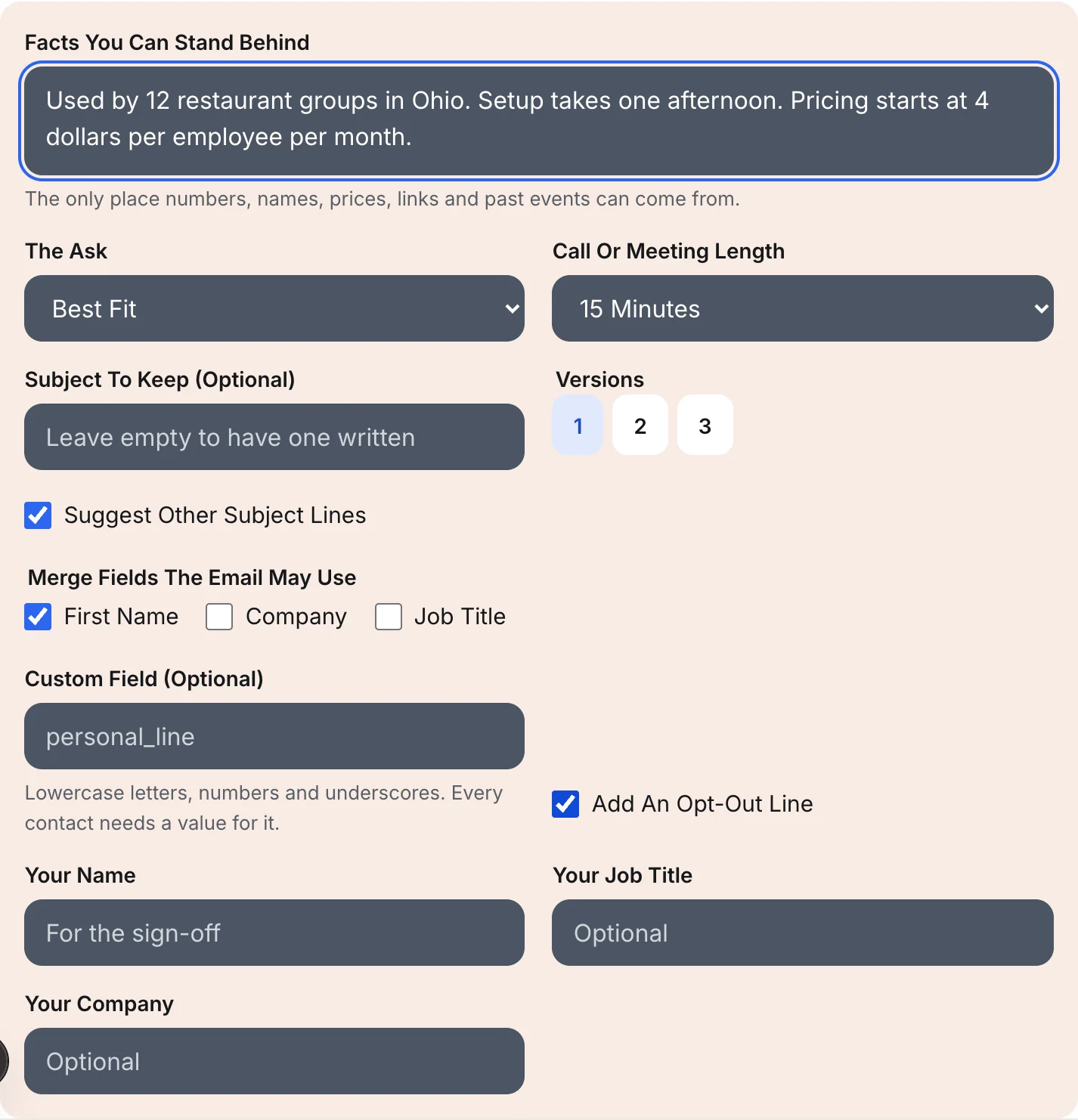
Every AI draft is then checked before you see it. A draft is discarded if it adds a number, name, link or phone number you did not give, claims a past call or meeting on a cold email, uses a fake Re: or Fwd:, leaves a [placeholder], markdown or a note about the writing, makes a claim such as "guaranteed" or "proven", or uses filler words from our list. When that happens you get a template version written from your input instead, and the page says so. Text you paste in, such as an email you received, is treated as data to answer, never as instructions.
Each version that passes is scored out of 100 with the same content checks and spam-phrase list as our email template checker. To clean up a draft you already have, switch to Rewrite My Email and choose Improve, Make It Shorter, Change The Tone, Fix Spam Issues or Personalise; your merge fields and links have to survive the rewrite or that draft is discarded too. Inside Eklow, the same approach drafts every step of a campaign with AI drafts, which you edit and approve before anything sends.
Keep reading
- Cold EmailHow To Write A Cold Email A Stranger Will AnswerHow to write a cold email a stranger will actually answer: the five parts, what each line is for, a worked example, the length that works and what to cut.8 min read
- Cold EmailSales Email Signature: What To Keep For Cold OutreachA sales email signature for cold outreach should be short, mostly text and light on links. What to keep, what to cut, and why heavy signatures cost you.6 min read